<?xml version="1.0" encoding="utf-8"?>
<feed xmlns="http://www.w3.org/2005/Atom" xml:base="https://memonsystems.com/" xml:lang="en">
  <title>Abdullah Memon | Legal RAG Compliance Architecture Blog Feed</title>
  <subtitle>Legal AI that retrieves the right law, and the evidence that it did. I build systems to that standard, and I measure existing ones against it. For legal-tech vendors whose enterprise sales to law firms are held up in risk assessment and SRA compliance.</subtitle>
  <link href="https://memonsystems.com/feed.xml" rel="self"/>
  <link href="https://memonsystems.com/" rel="alternate"/>
  <updated>2026-07-27T00:00:00Z</updated>
  <id>https://memonsystems.com/</id>
  <author>
    <name>Abdullah Memon</name>
    <email>contact@memonsystems.com</email>
  </author>
  <entry>
    <title>Code in JavaScript like a NASA Engineer</title>
    <link href="https://memonsystems.com/journal/code-in-javascript-like-nasa-engineer/"/>
    <updated>2025-06-03T00:00:00Z</updated>
    <id>https://memonsystems.com/journal/code-in-javascript-like-nasa-engineer/</id>
    
    <content type="html"><![CDATA[<p>We have all been there where we regretted not following the coding standard and become too flexible when coding a program. Using singleton pattern in one side and classes on the other, no don't quite remember if this function should contain &quot;new&quot; or not. This is result of bad code and having no system at all.</p>
<p>You introduced Typescript and decided to keep things simple like only using functions (functional programming), adding explicit types everywhere, adding return type, using more types and avoiding &quot;any&quot; wherever possible. Is that enough for reliable systems? Is it enough that you are confident where things are when introducing a new feature? Maybe not. We need a way to make our lives easier.</p>
<p>This article was inspired by NASA Programming Guidelines. You can read them here <a href="https://www.grc.nasa.gov/www/winddocs/guidelines/pgmstds.pdf">NASA Programming Guidelines</a>. We'll be using this knowledge for Typescript and general development.</p>
<h2>The Surface</h2>
<p>Following these guidelines would ensure you have code safety and reliability. You might think that following these set of rules is overcomplicating the simple which is true for situations like developing a small software or demo software but not true for developing real world applications. The application that you care about. It's difficult to follow these rules at the start but you will thank yourself later when adding more features.</p>
<p>It's worth noting about technical debt. Combining pieces together about coding philosophies, one would indicate that writing super good code doesn't matter. The code is flexible thing and requires frequent updates. Moment you write a &quot;perfect&quot; function and then you introduce an update where that function is not needed, if you could predict this moment then you wouldn't spent so much time making this function super good.</p>
<p>In short, you should not think too much about following the rules. You have to find a sweet spot or balanced version of safety and reliability, exception being where the code might run into spaceships or health care systems where minor error would potentially be disastrous. Most of the time, it's okay to not follow the system. But it's worth knowing how to create such systems and follow them by nature. It's better to get used to them and use them in flow state and not think about them explicitly.</p>
<h2>The Rules</h2>
<p>Create a set of rules that you have to follow. Like the following:</p>
<ol>
<li>Functional Programming whenever possible</li>
<li>Use object literal for similar functions and using similar property values across those functions.</li>
<li>Create modules where file contents are larger</li>
<li>Make repeatedly used variables global.</li>
</ol>
<p>and much more. You don't have to follow our example, as you might prefer monolith pattern for some reason which is okay. This is a system made by you and thus you will follow it. Also, it's better that rules are NOT more than 10.</p>
<p>Your rules should have clear tradeoffs. Like using functional programming to some extend would make it unable to have same benefits as OOP programming where inheritance and polymorphism is feasible. It's possible in functional programming too but with boilerplate and ugly hacks.</p>
<p>Write your rules and tradeoffs then refine.</p>
<h2>What we think</h2>
<p>You can make better rules if you have been in software development for long enough and have encountered problems, or it could be that you have run into less problems. In both cases, you should learn what patterns or rules may cause these problems. There are good and bad rules to follow. In order for you to write good rules and thus better system, you will have to experience the things that are built deeply where deeply nested modules are introduced and each module's nature is considered to determine expected output.</p>
<p>In any case, you should read the following to improve your system and add the rules.</p>
<ol>
<li>Avoid recursions. It causes logic to jump into different places. Also if the recursions are run long enough then memory tends to eat up as addresses are being noted by the compiler for each execution. Thus, do not use recursion, instead use the loop. The loops are created by programming language natively and are optimised to be used consistently. Why complicate things?</li>
<li>No infinite loops. The loops should always have an upper bound. There are certainly use cases where infinite loops make sense but you should avoid them as much as you can. The infinite loops that you may create must have a way to exit and such loop should be tested thoroughly to ensure all those exits work as expected. Otherwise, the computer would hang and if your program was the culprit, expect deletion from that and other products.</li>
<li>Keep fixed memory limit to use for the program. For example, there are ways in NodeJS to limit the memory usage for the program. You can do that to ensure that program uses less memory, runs on cheaper hardware, and does not go wild at some situation (due to bad logic).</li>
<li>Dynamic variables like Map, Set, and Arrays should have bounds. Imagine using such data type to add an item to todolist and do that a million times then wonder why is the program so slow, must be because of incompetent programmer.</li>
<li>Functions should not be longer than an A4 paper. Neither you nor we are gonna be able to read that function with happiness. Use modules with meaningful names and it's much better.</li>
<li>Do negative programming whenever possible. It is where you would add at least 2 assertions to the functions for the real world outputs. This way, it's better that program crashes with meaningful than use ambiguous data for further processing and all members in the network get to use that as well.</li>
<li>In some cases, you would not use return value of a function. It's better to explicitly explain why you did that. It would ensure better readability and understanding about your decision.</li>
<li>From start, no errors or warnings. Write it down. Check daily with analyser that there are no such error or warnings. It's common for us to ignore warnings. Even there are warnings to freshly scaffolded projects with templates. These are no good in the long term. They pose innocent but they are not. When connecting modules together and getting into the depth when needed, such is regretted to not have ignored that warning.</li>
</ol>
<p><strong>Notable libraries to use in JavaScript:</strong> Neverthrow, Biome, Zod, Jest, Playwright, TS Effect</p>
<h2>That's it</h2>
<p>There you go with knowledge to build resilient systems. Whether you should build them depends on how much you are paid. Make sure you are paid well to do that or you care that the system should be resilient for your own self. Writing rules and following is no easy but doing them from today and making a habit of it will make it easy for you when coding projects later. You will know how things will turn out if coded in such way.</p>
<p>In other cases, remember that code has no value. Be prepared that you will erase it soon to replace with something better.</p>
]]></content>
  </entry>
  <entry>
    <title>Crafting a Digital Sanctum: A Contemplation on the Self-Hosted Home Server</title>
    <link href="https://memonsystems.com/journal/building-self-hosted-home-server/"/>
    <updated>2025-09-06T00:00:00Z</updated>
    <id>https://memonsystems.com/journal/building-self-hosted-home-server/</id>
    
    <content type="html"><![CDATA[<h3>On Crafting a Digital Sanctum</h3>
<p>We have long felt a certain dissonance in the digital world. Our creations, our memories, our media, are so often scattered across services that feel ephemeral, held captive by subscriptions and opaque terms. It can feel as though we are merely tenants in our own digital lives. This quiet reflection has led us down a path, one that moves towards the creation of a personal sanctum. A self-hosted ecosystem, built not on convenience alone, but on sovereignty and a deep sense of deliberate design.</p>
<p>This is not a guide. These are simply our own thoughts for the technical mind contemplating the assembly of a bespoke <strong>home server setup</strong>. It is a meditation on building a personal cloud that is both powerful and profoundly intentional.</p>
<h3>A Map of Contemplation</h3>
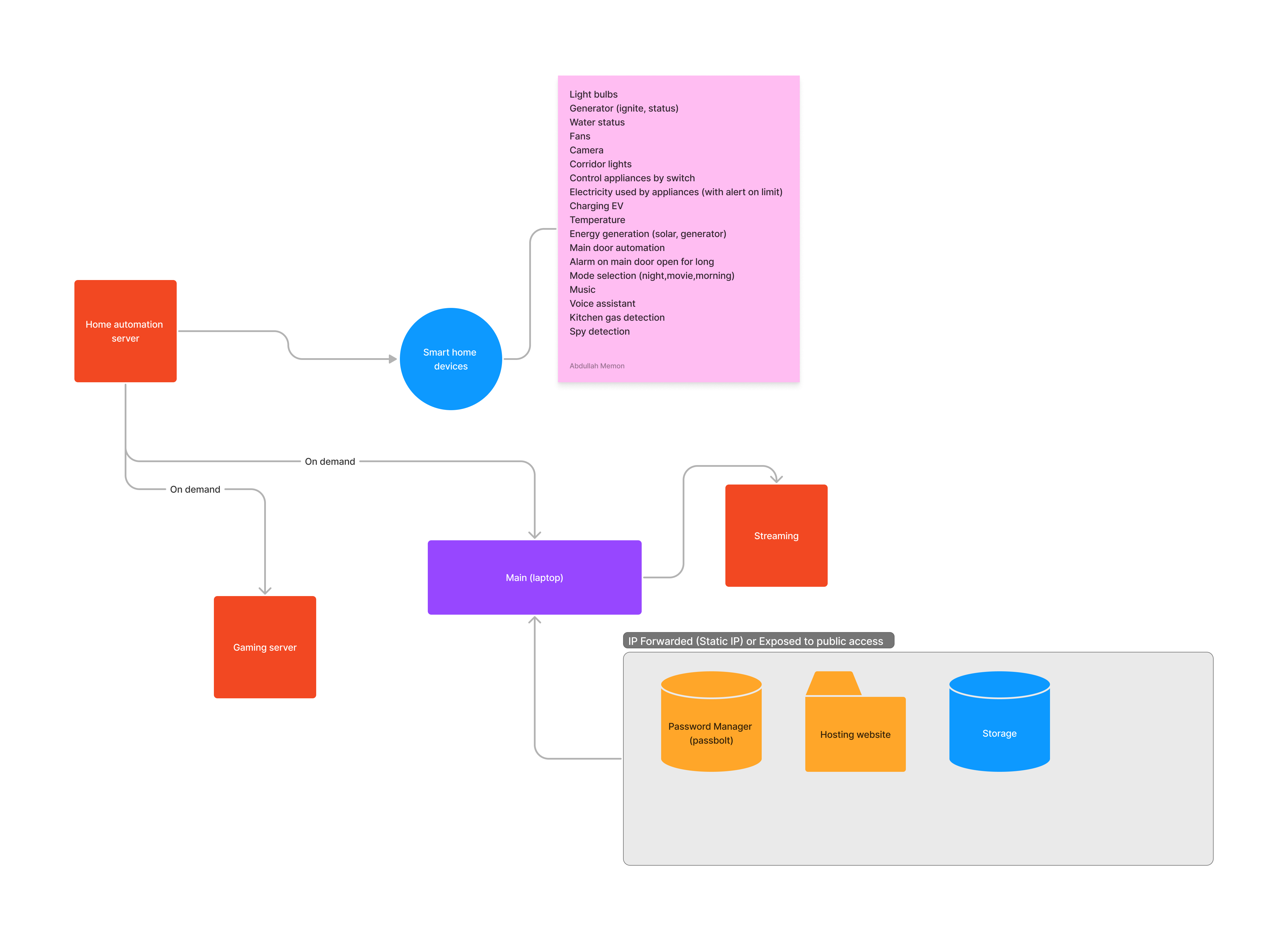
<p>Words can only convey so much of an architecture. Before exploring the philosophy behind the components, we have sketched out a map of these thoughts. It is a visual representation of how these distinct systems relate to one another, a blueprint for this digital sanctum.</p>
<p><img src="https://memonsystems.com/assets/blog/home-server.png" alt="A visual contemplation of the server architecture.">
<em>A visual contemplation of the server architecture.</em></p>
<h3>A Triptych of Purpose</h3>
<p>As the diagram illustrates, the thought of a single, monolithic machine attempting to be all things has never resonated with us. Such a device often becomes a collection of compromises, a master of nothing. Instead, we found a certain clarity in division, in creating a trinity of specialised machines. Each has its own purpose, allowing for an elegant balance of power and efficiency.</p>
<p>The foundation of this ecosystem is the <strong>Home Automation Server</strong>. It prioritises silence and discretion, the nervous system of the home, ever-present, yet completely unobtrusive. Its qualities are a minimal physical form and exceptionally low energy use, for it is always on, listening. It is the silent watcher that handles the small automations that bring a sense of seamlessness to the physical world, and it is the gatekeeper that awakens the more powerful machines when they are needed.</p>
<p>From this quiet core, our thoughts turn to the heart of the digital archive, the <strong>Main Server</strong>. This is a more capable machine, though still chosen for its efficiency over raw power. Its purpose is to be the steadfast guardian of our collective memories and culture. Here, we host a <strong>personal cloud storage</strong> solution, a private alternative to services like Dropbox, ensuring that our vital documents and photographs are held within these walls. It also serves as our streaming centre. The modern frustration of sitting down with family for a film, only to wrestle with buffering streams or sudden unavailability, is something we sought to eliminate. Using platforms like <strong>Plex or Jellyfin</strong>, this server serves our curated library of film and television from local disk, whenever we wish.</p>
<p>Finally, there is the ephemeral arena, the <strong>Gaming Server</strong>. Power is a resource that commands respect, and high-end components have a thirst for electricity. This server, built for pure performance, remains dormant by default. It is brought to life only by a deliberate action from the automation server when its strength is truly needed. This is our philosophy of on-demand computing. Its goal is ambitious. We envision a centralised gaming rig powerful enough to stream experiences to any device in the home. We have found <strong>Parsec</strong> to be a remarkable tool for this, allowing graphically intensive titles to be played on an old laptop or even a smartphone.</p>
<h3>The Developer’s Private Forge</h3>
<p>Building a <strong>self-hosting</strong> infrastructure is ultimately an act of reclaiming a certain control. For a <strong>full stack developer</strong>, this extends beyond data into the very craft of software.</p>
<p>While our daily work unfolds on an M4 MacBook, its screen a vast 34-inch 4k VA panel, the allure of a self-hosted development environment remains. The power of our local machine is not in question, but the server offers a different kind of freedom. An instance of <strong>code-server</strong> running on the main server provides the full strength of a desktop development environment, accessible from any browser, on any device. It untethers the act of creation from a single physical place. It also presents a secure, private way to share in-progress work. The challenge, of course, is security. Our current path involves exposing only a single, heavily fortified port to the world, channelling everything through a meticulously configured reverse proxy. There is an elegance to this minimalist approach.</p>
<h3>The Sanctum's Potential</h3>
<p>The result of this deliberate construction is not merely a collection of services, but a quiet expansion of personal capability. In essence, the potential of such a sanctum includes:</p>
<ul>
<li>A private vault for passwords, shielded from third-party services.</li>
<li>A personal cinema, with a curated library ready at a moment's notice.</li>
<li>An arena for gaming, streamed effortlessly to any screen in the home.</li>
<li>A complete personal cloud for files, calendars, and contacts.</li>
<li>Sovereignty over the home's security, lighting, and access.</li>
<li>Oversight of essential utilities, like water levels and energy stores.</li>
<li>A secluded space for personal project management and notes.</li>
<li>A trusted channel for private conversations.</li>
<li>A secure tunnel to the digital world through a personal VPN.</li>
</ul>
<p>This journey is not about finding the easiest path. It is about the deliberate act of building, of truly understanding the systems we rely upon, and of crafting a digital life that is an authentic reflection of ourselves. The code, the configuration, the very architecture, it should all whisper of its purpose, an elegant solution born from quiet contemplation.</p>
]]></content>
  </entry>
  <entry>
    <title>Context Engineering: The Hidden Art of Building with AI</title>
    <link href="https://memonsystems.com/journal/context-engineering-the-hidden-art-of-building-with-ai/"/>
    <updated>2025-11-09T00:00:00Z</updated>
    <id>https://memonsystems.com/journal/context-engineering-the-hidden-art-of-building-with-ai/</id>
    
    <content type="html"><![CDATA[<p>We've been thinking about something that most developers miss when working with coding agents.</p>
<p>The best programmers aren't those who write the most elegant algorithms. They're the ones who communicate clearly. This truth becomes sharper when building with AI.</p>
<h2>The Real Work Happens Before the Code</h2>
<p>When a model fails to output what you need, the problem isn't the model. You haven't understood your own requirements deeply enough.</p>
<p>We structure our work around specs—multiple layers of them:</p>
<p><strong>API documentation</strong> defines the contracts. <strong>Base goals</strong> anchor the vision. <strong>Coding style</strong> maintains consistency. And crucially: no assumptions, no bias. Just clear boundaries.</p>
<p>Then we attach examples. Real ones. The model needs to see what success looks like in your context.</p>
<p>Supply these specs by feature, not all at once. Feed the intelligence what it needs when it needs it.</p>
<h2>A Glimpse Into Tomorrow</h2>
<p>The software company of the future looks different than today's structure.</p>
<p>Programmers write code specs. Product managers write product specs. Legal teams write legal specs. And someone new emerges: <strong>AI engineers who synthesize everything</strong>, wielding models as instruments to build the actual product.</p>
<p>This person understands systems. They solve human problems through orchestration rather than implementation.</p>
<h2>What About Writing Code?</h2>
<p>Coding remains part of engineering. But it's not the end goal—it never was.</p>
<p>Engineering is about understanding systems and solving human problems. The code is simply one expression of that understanding.</p>
<p>When you provide your <code>biome.json</code> and style configurations to the model, you're not just setting preferences. You're encoding years of architectural decisions into a language the model comprehends.</p>
<p>The elegance isn't in the code itself. It's in how clearly you've thought through what needs to exist.</p>
<h2>Let Your Specifications Whisper</h2>
<p>We don't believe in tutorials that hold your hand through every keystroke. Better to share the philosophy and let capable minds extrapolate.</p>
<p>If you can't write a spec that produces what you envision, you don't understand your vision yet. Keep refining until the path becomes clear.</p>
<p>The future belongs to those who can translate human intention into systematic instruction—whether the executor is human or machine.</p>
<p>Build with clarity. The rest follows.</p>
]]></content>
  </entry>
  <entry>
    <title>When Safari Becomes the Silent Enemy</title>
    <link href="https://memonsystems.com/journal/when-safari-becomes-the-silent-enemy/"/>
    <updated>2025-11-11T00:00:00Z</updated>
    <id>https://memonsystems.com/journal/when-safari-becomes-the-silent-enemy/</id>
    
    <content type="html"><![CDATA[<p>There's something humbling about spending days solving a problem that shouldn't exist.</p>
<p>We needed video sessions. Simple 1-to-1 connections where two people could see each other. The architecture was straightforward—sessions as rooms, tokens as identities, API keys for operations, secrets for server-side generation. Clean. Minimal. Elegant.</p>
<p>AWS didn't work. LiveKit failed. Every major solution crumbled on iOS Safari.</p>
<p>Not because the code was wrong. Not because the APIs were broken. They worked perfectly in Chrome, Firefox, even Safari on macOS. The issue was iOS—specifically older versions that people still carry in their pockets today.</p>
<h2>The Pattern That Emerged</h2>
<p>Each attempt followed the same ritual. Create a session. Generate tokens for each participant. Connect. Publish streams. Handle remote streams. The subscriber model for broadcasts was equally simple—publishers stream, subscribers watch, no camera permissions needed.</p>
<p>Everything worked. Until it didn't.</p>
<p>iOS Safari has its own interpretation of WebRTC standards. Its own quirks with getUserMedia. Its own silent failures that leave no meaningful traces in console logs.</p>
<h2>The Solution Nobody Mentions</h2>
<p>Vonage's architecture understood something the others missed. Not every platform implements standards the same way. Their system accounts for Safari's peculiarities—the permission flows, the codec preferences, the connection lifecycle that iOS manages differently.</p>
<p>It worked immediately.</p>
<p>No configuration gymnastics. No platform detection hacks. No conditional rendering based on user agents. The architecture simply acknowledged reality—iOS Safari exists in its own world, and you either build for that world or watch your users leave.</p>
<h2>What This Reveals</h2>
<p>Modern iOS versions might handle these issues better. Perhaps they do. But legacy devices persist. Users don't upgrade on your timeline. They use what they have, and what they have often runs older Safari builds with older WebRTC implementations.</p>
<p>This isn't about blaming Apple or praising Vonage. It's about recognizing that elegant code means nothing if the platform refuses to execute it. Sometimes the minimalist approach isn't writing less—it's choosing dependencies that already understand the landscape.</p>
<p>The best solution is the one that works silently, without explanation, without documentation diving, without GitHub issue archaeology. Vonage provided that. The video streams appeared. The connections held. The sessions persisted.</p>
<p>That's all that matters.</p>
<hr>
<p><em>Some problems only reveal themselves in production. Some solutions only prove themselves through absence of issues.</em></p>
]]></content>
  </entry>
  <entry>
    <title>Decoupling POSIX from Object Storage: The JuiceFS Architecture</title>
    <link href="https://memonsystems.com/journal/juicefs-decoupling-posix-metadata-from-object-storage/"/>
    <updated>2026-07-17T00:00:00Z</updated>
    <id>https://memonsystems.com/journal/juicefs-decoupling-posix-metadata-from-object-storage/</id>
    
    <content type="html"><![CDATA[<p>Most &quot;infinite storage&quot; solutions are expensive marketing abstractions built on fragile synchronization layers. They break under real production pressure. JuiceFS actually works because of a clean, uncompromising architectural split.</p>
<p>Here is the teardown of how it functions under the hood, and why its design makes sense for high-scale infrastructure.</p>
<hr>
<h2>The Core Split: POSIX vs. REST</h2>
<p>Applications expect files and directories via standard POSIX system calls. Cloud storage operates on flat S3 keys and HTTP REST verbs. Forcing the latter to pretend to be the former usually ends in performance degradation or consistency errors.</p>
<p>JuiceFS splits this problem in half:</p>
<ol>
<li><strong>Metadata</strong>: Placed in high-performance, low-latency engines (like Redis, Postgres, or TiKV).</li>
<li><strong>Raw Data Blocks</strong>: Placed in cheap, infinite, durable object storage (like S3 or GCS).</li>
</ol>
<pre class="language-mermaid"><code class="language-mermaid"><span class="token keyword">graph</span> TD
    App<span class="token text string">[Application]</span> <span class="token arrow operator">--></span><span class="token label property">|POSIX Calls: read/write/open|</span> FUSE<span class="token text string">[FUSE Client / VFS]</span>
    FUSE <span class="token arrow operator">--></span><span class="token label property">|1. Metadata Ops: lookup/create/chmod|</span> Meta<span class="token text string">[Metadata Engine: Redis / Postgres / TiKV]</span>
    FUSE <span class="token arrow operator">--></span><span class="token label property">|2. Data Ops: 4MB Chunks|</span> Cache<span class="token text string">[Local Cache / Staging Buffer]</span>
    Cache <span class="token arrow operator">--></span><span class="token label property">|Read/Write Block|</span> S3<span class="token text string">[Object Storage: S3 / GCS / Azure]</span>
    
    <span class="token keyword">style</span> App <span class="token style"><span class="token property">fill</span><span class="token operator">:</span>#000<span class="token punctuation">,</span><span class="token property">stroke</span><span class="token operator">:</span>#333<span class="token punctuation">,</span><span class="token property">stroke-width</span><span class="token operator">:</span>2px</span>
    <span class="token keyword">style</span> Meta <span class="token style"><span class="token property">fill</span><span class="token operator">:</span>#000<span class="token punctuation">,</span><span class="token property">stroke</span><span class="token operator">:</span>#0288d1<span class="token punctuation">,</span><span class="token property">stroke-width</span><span class="token operator">:</span>2px</span>
    <span class="token keyword">style</span> S3 <span class="token style"><span class="token property">fill</span><span class="token operator">:</span>#000<span class="token punctuation">,</span><span class="token property">stroke</span><span class="token operator">:</span>#388e3c<span class="token punctuation">,</span><span class="token property">stroke-width</span><span class="token operator">:</span>2px</span></code></pre>
<p>When your OS mounts JuiceFS, the client registers a virtual filesystem via FUSE. Your application performs standard disk operations, believing it is writing to local NVMe storage. In reality, the client is converting these calls into metadata updates in your database and parallel block uploads to S3.</p>
<hr>
<h2>Memory Latency and the Single-Thread Bottleneck</h2>
<p>Under heavy memory pressure, the OS evicts inactive memory pages to disk. For databases like Redis, which run on a single-threaded event loop, a page fault is catastrophic: a single disk access blocks the entire process, stalling all filesystem operations.</p>
<p>JuiceFS avoids this failure mode by keeping its local cache heap-allocated. By managing memory in the user space rather than relying on OS-level page cache eviction, lookup times remain predictable in the microsecond range.</p>
<hr>
<h2>Zero-Code Integration and the 5TB File Test</h2>
<p>Implementing JuiceFS requires no API integration or code modifications. Because it operates at the filesystem layer (VFS/FUSE), a legacy 15-year-old application or a modern ML pipeline can write to infinite storage instantly.</p>
<p>Standard cloud-syncing clients (e.g., OneDrive or Dropbox) handle large files by attempting to download the entire file when accessed. On a 5TB file, this crashes the local system.</p>
<p>JuiceFS handles this via <strong>immutable 4MB chunking</strong>:</p>
<ul>
<li>A 5TB file is split into millions of 4MB blocks stored in S3.</li>
<li>If an application reads a few bytes halfway through the file, the client queries the metadata engine to resolve the exact block offset.</li>
<li>It fetches <em>only</em> the single 4MB block containing those bytes from S3.</li>
<li>The remaining blocks stay in the cloud, untouched.</li>
</ul>
<p>This chunk-based retrieval guarantees that large file access is fast and doesn't exhaust local disk space. For local development, this allows engineering teams to work on baseline 256GB Apple hardware while mounting multi-terabyte datasets locally with microsecond metadata access.</p>
<hr>
<h2>Engine-Agnostic Metadata Layer</h2>
<p>The metadata engine is pluggable, letting you trade off latency for volume depending on the workload:</p>
<table>
<thead>
<tr>
<th style="text-align:left">Metadata Engine</th>
<th style="text-align:left">Primary Use Case</th>
<th style="text-align:left">Scale Target</th>
</tr>
</thead>
<tbody>
<tr>
<td style="text-align:left"><strong>Redis</strong></td>
<td style="text-align:left">Low-latency transactions, local development, small-to-medium datasets</td>
<td style="text-align:left">Millions of files</td>
</tr>
<tr>
<td style="text-align:left"><strong>TiKV / RocksDB</strong></td>
<td style="text-align:left">Scaled clustering, high-throughput writes</td>
<td style="text-align:left">Billions of files</td>
</tr>
<tr>
<td style="text-align:left"><strong>PostgreSQL</strong></td>
<td style="text-align:left">Operational simplicity, leveraging existing relational infrastructure</td>
<td style="text-align:left">Tens of millions of files</td>
</tr>
<tr>
<td style="text-align:left"><strong>BadgerDB</strong></td>
<td style="text-align:left">Single-node embedded deployments, local testing</td>
<td style="text-align:left">Millions of files</td>
</tr>
</tbody>
</table>
<p>This architectural flexibility means the same filesystem client runs identically on a Raspberry Pi or on a massive Kubernetes cluster training AI models.</p>
<hr>
<h2>The Engineering Costs</h2>
<p>JuiceFS is not magic; it is a system that makes explicit, honest trade-offs:</p>
<ul>
<li>If your metadata database (e.g., Redis) fails, the filesystem freezes immediately to guarantee data consistency. You are trading database availability for filesystem integrity.</li>
<li>Accessing data not present in the local cache incurs a round-trip network tax to S3. This latency must be factored into application performance profiles.</li>
<li>Running in writeback mode requires provisioning and monitoring a local staging directory. If the local disk fills up before flushing to S3, writes will block.</li>
</ul>
<p>These are not architectural bugs; they are the correct operational trade-offs for mapping POSIX semantics directly onto object storage without data corruption.</p>
]]></content>
  </entry>
  <entry>
    <title>The EU AI Act &amp; Legal RAG: Why &#39;Approve&#39; Buttons Fail Compliance Audits and How to Build Deterministic Human Oversight</title>
    <link href="https://memonsystems.com/journal/eu-ai-act-and-legal-rag-why-approve-buttons-fail-compliance-audits-and-how-to-build-deterministic-human-oversight/"/>
    <updated>2026-07-26T00:00:00Z</updated>
    <id>https://memonsystems.com/journal/eu-ai-act-and-legal-rag-why-approve-buttons-fail-compliance-audits-and-how-to-build-deterministic-human-oversight/</id>
    
    <content type="html"><![CDATA[<h2>1. The Compliance Illusion</h2>
<p>Every legal-tech RAG platform shipping into the EU market in 2026 has an &quot;Approve&quot; button. The lawyer reads the AI-generated clause summary, clicks approve, and the output enters the workflow. The vendor's compliance documentation cites this interaction as satisfying EU AI Act Article 14 — <em>&quot;Human Oversight.&quot;</em></p>
<p>It does not.</p>
<p>Article 14 does not require a human to <em>see</em> the output. It requires the deployer to ensure that natural persons exercising oversight are enabled to <em>&quot;properly monitor&quot;</em> the high-risk AI system, <em>&quot;interpret&quot;</em> its output, and <em>&quot;decide not to use&quot;</em> it or to <em>&quot;intervene&quot;</em> on it. A binary approve/reject button over a fully-rendered response satisfies none of these conditions. The lawyer cannot monitor the inference process. The lawyer cannot interpret which claims are grounded and which are fabricated. The lawyer's only intervention mechanism — clicking &quot;reject&quot; — triggers a full regeneration with no guarantee that the same failure mode won't repeat.</p>
<p>This is the compliance illusion that is currently embedded in the architecture of nearly every legal-tech RAG system entering regulated markets. It is not a UI problem. It is a structural deficiency in the generation path — and it creates bilateral liability exposure that no amount of prompt engineering can resolve.</p>
<blockquote class="markdown-alert markdown-alert-warning">
<p class="markdown-alert-title"><svg class="markdown-alert-icon" viewBox="0 0 16 16" width="16" height="16" fill="currentColor"><path d="M6.457 1.047c.66-1.077 2.426-1.077 3.086 0l6.082 9.93c.66 1.078-.22 2.523-1.543 2.523H1.918C.595 13.5-.285 12.055.375 10.978l6.082-9.93zM8 4a.75.75 0 0 0-.75.75v3.5a.75.75 0 0 0 1.5 0v-3.5A.75.75 0 0 0 8 4zm1 6a1 1 0 1 0-2 0 1 1 0 0 0 2 0z"></path></svg>Warning</p><p><strong>Bilateral Liability.</strong> The EU AI Act creates exposure for <em>both</em> the platform operator (as a deployer of a high-risk AI system under Articles 14–15) and the practising lawyer (under SRA Principle 2 / ABA Model Rule 1.1 / Codice Deontologico Forense Articles 9 and 12) simultaneously. A single fabricated citation that passes through the &quot;approve&quot; button and reaches a tribunal creates a compliance incident for the vendor's Article 15 (Accuracy) obligations <em>and</em> a professional conduct violation for the lawyer's duty of competence — regardless of whether the lawyer clicked &quot;approve&quot; in good faith.</p>
</blockquote>
<p>This article breaks down <em>why</em> the standard approve/reject pattern fails under regulatory scrutiny, identifies the four specific compliance gaps it creates, and presents the deterministic architectural safeguards — entity masking, forced-intervention routing, in-flight NLI verification, and shadow AI telemetry — that convert human oversight from a UI fiction into a mechanistic, auditable compliance property.</p>
<p>The analysis draws on architectural patterns validated across multiple legal-tech RAG engagements and is grounded in the specific regulatory provisions that enterprise procurement teams evaluate during TPRM (Third-Party Risk Management) questionnaires.</p>
<hr>
<h2>2. The Regulatory Physics: What the EU AI Act Actually Requires</h2>
<h3>2.1 Article 14 — Human Oversight: The Three Conditions</h3>
<p>Article 14(4) of the EU AI Act specifies that natural persons assigned to exercise oversight must be enabled to:</p>
<table>
<thead>
<tr>
<th style="text-align:left">Condition</th>
<th style="text-align:left">What It Requires</th>
<th style="text-align:left">What the &quot;Approve&quot; Button Provides</th>
</tr>
</thead>
<tbody>
<tr>
<td style="text-align:left"><strong>(a)</strong> Properly understand the capacities and limitations of the system</td>
<td style="text-align:left">The user must know what the system can and cannot do — including its failure modes, confidence boundaries, and known weaknesses.</td>
<td style="text-align:left">Nothing. The button renders a finished output with no metadata about retrieval quality, grounding status, or confidence thresholds.</td>
</tr>
<tr>
<td style="text-align:left"><strong>(b)</strong> Properly monitor its operation</td>
<td style="text-align:left">The user must be able to observe the system's behaviour during operation — detecting anomalies, unintended outputs, and degradation.</td>
<td style="text-align:left">Nothing. The system generates the full response behind an opaque inference boundary, then presents the completed text. The user monitors nothing; they evaluate a fait accompli.</td>
</tr>
<tr>
<td style="text-align:left"><strong>(d)</strong> Decide not to use the system, or intervene on its operation</td>
<td style="text-align:left">The user must have meaningful intervention mechanisms — not just accept/reject, but the ability to modify, constrain, or redirect the system's behaviour.</td>
<td style="text-align:left">A binary button. Accept the full response or reject the full response. No granular intervention. No ability to accept sentences 1–3 and reject sentence 4. No mechanism to constrain the regeneration path.</td>
</tr>
</tbody>
</table>
<p>The gap is structural, not cosmetic. The approve/reject pattern was designed for human workflows where a senior lawyer reviews a junior's draft — a context where the reviewer has full domain expertise, can independently verify every claim, and operates under professional obligations to do so. When the &quot;junior&quot; is an LLM generating text at 80 tokens/second from a 6M-document corpus, the reviewer cannot independently verify the claims, cannot observe the generation process, and has no mechanism to intervene at a granular level. The supervisory model breaks.</p>
<h3>2.2 Article 15 — Accuracy: The Measurement Gap</h3>
<p>Article 15 requires that high-risk AI systems achieve <em>&quot;an appropriate level of accuracy&quot;</em> — and that this accuracy is <em>&quot;communicated to the deployer.&quot;</em></p>
<p>This creates a specific technical obligation: the platform must measure accuracy, not just assert it. A marketing claim of &quot;sub-1% hallucination rate&quot; based on aggregate benchmark scores does not satisfy Article 15 unless the deployer can verify the claim against their specific use case and the system provides ongoing accuracy telemetry — not just a one-time evaluation.</p>
<p>Our own engagements have documented systems marketed with sub-1% hallucination guarantees that exhibited <strong>100% failure rates on structurally predictable query classes</strong> — systems that passed aggregate benchmarks while catastrophically failing on article-number collisions, cross-statute retrieval, and fabricated sub-clause traps. Aggregate accuracy is not accuracy. It is an average that conceals failure modes.</p>
<p>Article 15 compliance requires:</p>
<ol>
<li><strong>Per-query grounding verification</strong> — not post-hoc batch evaluation, but runtime verification of each generated claim against its source evidence.</li>
<li><strong>Continuous accuracy telemetry</strong> — a live dashboard tracking hallucination rate, retrieval precision, and grounding coverage over time, accessible to the deployer.</li>
<li><strong>Failure-mode documentation</strong> — explicit disclosure of known query classes where the system's accuracy degrades (e.g., shared identifier collisions, multi-statute ambiguity, temporal law conflicts).</li>
</ol>
<h3>2.3 Article 10 — Data Governance: The Ingestion Leak</h3>
<p>Article 10 requires that training, validation, and testing datasets be <em>&quot;relevant, sufficiently representative, and to the best extent possible, free of errors.&quot;</em> For RAG systems, the &quot;dataset&quot; is not the LLM's training data — it is the document corpus ingested into the vector database. This shifts the data governance obligation from the model provider to the platform operator.</p>
<p>The compliance implication is direct: if the ingestion pipeline stores unmasked PII, confidential client data, or privileged legal communications in the vector database, the system's data governance controls are deficient under Article 10 — regardless of whether the generation model itself is compliant.</p>
<p>This is where entity masking becomes a compliance requirement, not a privacy feature.</p>
<hr>
<h2>3. The Four Compliance Gaps in Standard Legal RAG Architectures</h2>
<p>Based on our architectural assessments across multiple legal-tech RAG platforms, the following four gaps appear with near-universal frequency. Each gap maps to a specific regulatory provision and creates a specific failure mode that enterprise TPRM questionnaires are designed to surface.</p>
<h3>Gap 1: No Per-Sentence Grounding Verification (Articles 14 &amp; 15)</h3>
<p>Standard architectures generate multi-sentence responses and either ship them unverified or apply a post-hoc evaluation gate after completion. This creates a compliance-free window between the first hallucinated token and the completion of the response. Contaminated tokens persist in the key-value cache and condition all subsequent generation, forcing the post-hoc gate to catch errors only after they propagate through the entire output.</p>
<p>This failure mode prevents compliance with Article 14(4)(b) monitoring obligations. Without intermediate verification states, deployers cannot isolate which individual claims are grounded versus fabricated.</p>
<blockquote>
<p><em>TPRM questionnaire probe:</em> Describe the runtime verification controls on the AI system's output. At what granularity are generated claims verified against source evidence? Provide sample audit logs demonstrating per-claim verification with source attribution.</p>
</blockquote>
<h3>Gap 2: No Entity Masking on the Inference Path (Article 10)</h3>
<p>Standard pipelines ingest raw legal documents into vector databases with party names, deal values, and privileged matter details intact. When these unmasked chunks are retrieved into shared context windows, the attention mechanism risks cross-matter data contamination.</p>
<p>Even under an executed Data Processing Agreement, displaying unmasked client data across matters breaches internal ethical walls and legal confidentiality rules.</p>
<blockquote>
<p><em>TPRM questionnaire probe:</em> How does the system prevent cross-matter data contamination in multi-tenant deployments? Describe entity isolation controls at the inference layer.</p>
</blockquote>
<h3>Gap 3: No Deterministic Clause Flagging &amp; Forced Human Intervention (Article 14)</h3>
<p>When platforms generate complete contracts and present only a single approve/reject toggle, practitioners routinely approve multi-page drafts without reviewing high-risk terms such as liability caps or indemnification provisions.</p>
<p>Article 14(4)(d) mandates the ability to intervene on system operation. A single binary toggle over a complex document fails this requirement because it lacks intervention granularity.</p>
<blockquote>
<p><em>TPRM questionnaire probe:</em> Does the system flag high-risk legal terms (indemnification, warranty, liability caps) for mandatory human review before document generation completes? Describe the flagging logic and the forced-intervention mechanism.</p>
</blockquote>
<h3>Gap 4: No Shadow AI Detection (Articles 14 &amp; 15)</h3>
<p>When internal enterprise tools experience latency spikes, practitioners often copy draft text from unmonitored consumer models into the enterprise interface. If the platform logs this text as human-authored, an unmonitored external model enters the privileged legal workflow undetected.</p>
<p>This creates compliance blind spots under Article 14 monitoring rules and breaches professional conduct obligations regarding unverified AI assistance.</p>
<blockquote>
<p><em>TPRM questionnaire probe:</em> How does the system detect and flag content pasted from external AI tools? Describe the anti-shadow-AI controls and the escalation workflow.</p>
</blockquote>
<hr>
<h2>4. The Engineering Overhaul: Four Deterministic Compliance Safeguards</h2>
<p>Each safeguard maps to a specific gap identified in §3 and is designed to convert human oversight from a passive UI checkbox into an active, mechanistic, auditable compliance property.</p>
<h3>Safeguard A: Entity Masking Engine — Pre-Display Sanitisation</h3>
<p>Addressing Gap 2 (Article 10 — Data Governance), the system masks all identifying entities before display and rehydrates them only after human review and approval. This ensures legal analysis is evaluated on substantive merits rather than client identity.</p>
<pre class="language-mermaid"><code class="language-mermaid"><span class="token keyword">flowchart</span> LR
    <span class="token keyword">subgraph</span> Ingestion <span class="token text string">["Ingestion Path"]</span>
        <span class="token keyword">direction</span> TB
        D<span class="token text string">[Raw Document]</span> <span class="token arrow operator">--></span> P<span class="token text string">[NER Extraction&lt;br/>spaCy + Custom Legal NER]</span>
        P <span class="token arrow operator">--></span> M<span class="token text string">["Entity Registry&lt;br/>(Encrypted, Per-Matter)"]</span>
        P <span class="token arrow operator">--></span> C<span class="token text string">[Masked Chunks&lt;br/>→ Vector DB]</span>
    <span class="token keyword">end</span>

    <span class="token keyword">subgraph</span> Inference <span class="token text string">["Inference Path"]</span>
        <span class="token keyword">direction</span> TB
        Q<span class="token text string">[User Query]</span> <span class="token arrow operator">--></span> R<span class="token text string">[Retrieve&lt;br/>Masked Chunks]</span>
        R <span class="token arrow operator">--></span> G<span class="token text string">[LLM Generation&lt;br/>with Masked Context]</span>
        G <span class="token arrow operator">--></span> Display<span class="token text string">["Display to Associate:&lt;br/>[Client_Entity_A] acquires&lt;br/>[Target_Entity_B] for&lt;br/>[Consideration_Value_1]"]</span>
    <span class="token keyword">end</span>

    <span class="token keyword">subgraph</span> Rehydration <span class="token text string">["Post-Approval Rehydration"]</span>
        <span class="token keyword">direction</span> TB
        Display <span class="token arrow operator">--></span> Approve<span class="token text string">{Associate&lt;br/>Approves?}</span>
        Approve <span class="token arrow operator">--></span><span class="token label property">|Yes|</span> Rehydrate<span class="token text string">["Rehydrate Entities&lt;br/>from Registry"]</span>
        Rehydrate <span class="token arrow operator">--></span> Final<span class="token text string">[Final Document&lt;br/>with Real Names]</span>
        Approve <span class="token arrow operator">--></span><span class="token label property">|No|</span> Edit<span class="token text string">[Associate Edits&lt;br/>Masked Draft]</span>
    <span class="token keyword">end</span></code></pre>
<p><strong>What the associate sees:</strong></p>
<table>
<thead>
<tr>
<th style="text-align:left">Before Masking</th>
<th style="text-align:left">After Masking</th>
</tr>
</thead>
<tbody>
<tr>
<td style="text-align:left"><em>&quot;Apple Inc. agrees to acquire Acme Corp for $500,000,000 subject to the indemnification provisions of Section 8.3.&quot;</em></td>
<td style="text-align:left"><em>&quot;<strong>[Client_Entity_A]</strong> agrees to acquire <strong>[Target_Entity_B]</strong> for <strong>[Consideration_Value_1]</strong> subject to the indemnification provisions of <strong>[Section_Ref_1]</strong>.&quot;</em></td>
</tr>
</tbody>
</table>
<p><strong>Why this matters for compliance:</strong></p>
<ol>
<li><strong>Cross-matter contamination is eliminated.</strong> The LLM never receives unmasked entity names in its context window. Even if chunks from different matters are accidentally co-retrieved, the masked tokens carry no identifying information.</li>
<li><strong>Ethical wall enforcement becomes architectural.</strong> The masking is not a UI layer that can be bypassed — it operates at the vector database level. The chunks stored in the index are pre-masked. There is no &quot;view unmasked&quot; toggle.</li>
<li><strong>The Entity Registry is per-matter, encrypted, and access-controlled.</strong> Rehydration requires matter-level authorisation. An associate working on Matter A cannot rehydrate entities from Matter B — the registry enforces the wall.</li>
</ol>
<p>The core NER extraction and pseudonymisation logic powering this safeguard is available as an open-source reference implementation: <a href="https://github.com/azterizm/legal-rag-mask"><code>legal-rag-mask</code></a>. It ships with pre-configured entity categories for legal text (parties, monetary values, dates, section references, jurisdiction markers), deterministic pseudonym generation for cross-document consistency, and a rehydration API for post-approval entity restoration. Drop it into your ingestion pipeline to close the Article 10 gap before your next TPRM review.</p>
<h3>Safeguard B: Deterministic Red-Teaming &amp; Forced Intervention Routing</h3>
<p>Addressing Gap 3 (Article 14 — Granular Human Intervention), a deterministic classifier scans generated output for high-risk legal terms, enforcing explicit confirmation gates on flagged clauses prior to document finalisation.</p>
<p>A lightweight classifier (fine-tuned 8B or a rule-based spaCy pipeline) scans the generated output for a configurable lexicon of high-risk terms:</p>
<table>
<thead>
<tr>
<th style="text-align:left">Category</th>
<th style="text-align:left">Trigger Terms</th>
<th style="text-align:left">Forced Action</th>
</tr>
</thead>
<tbody>
<tr>
<td style="text-align:left"><strong>Liability</strong></td>
<td style="text-align:left"><code>indemnif*</code>, <code>hold harmless</code>, <code>limitation of liability</code>, <code>consequential damages</code></td>
<td style="text-align:left">Hard gate: associate must confirm £/$ cap value against client mandate</td>
</tr>
<tr>
<td style="text-align:left"><strong>Warranty</strong></td>
<td style="text-align:left"><code>warrants</code>, <code>represents</code>, <code>guarantees</code>, <code>ensures</code>, <code>covenants</code></td>
<td style="text-align:left">Hard gate: associate must confirm warranty scope against client instructions</td>
</tr>
<tr>
<td style="text-align:left"><strong>Governing Law</strong></td>
<td style="text-align:left"><code>governing law</code>, <code>jurisdiction</code>, <code>arbitration</code>, <code>exclusive jurisdiction</code></td>
<td style="text-align:left">Hard gate: associate must confirm jurisdiction against client preference</td>
</tr>
<tr>
<td style="text-align:left"><strong>Termination</strong></td>
<td style="text-align:left"><code>terminate for convenience</code>, <code>material breach</code>, <code>cure period</code></td>
<td style="text-align:left">Soft flag: highlighted for review but not gated</td>
</tr>
<tr>
<td style="text-align:left"><strong>Data / IP</strong></td>
<td style="text-align:left"><code>intellectual property</code>, <code>data processing</code>, <code>sub-processor</code>, <code>confidential information</code></td>
<td style="text-align:left">Hard gate: associate must confirm scope against DPA requirements</td>
</tr>
</tbody>
</table>
<pre class="language-mermaid"><code class="language-mermaid"><span class="token keyword">sequenceDiagram</span>
    <span class="token keyword">participant</span> LLM as Generation Tier
    <span class="token keyword">participant</span> Clf as Clause Classifier
    <span class="token keyword">participant</span> UI as Associate Interface
    <span class="token keyword">participant</span> Log as Audit Trail

    LLM<span class="token arrow operator">->></span>Clf<span class="token operator">:</span> Document <span class="token text string">(15 paragraphs)</span>
    Clf<span class="token arrow operator">->></span>Clf<span class="token operator">:</span> Scan trigger terms
    <span class="token keyword">Note over</span> Clf<span class="token operator">:</span> 3 flags<span class="token operator">:</span> ¶9, ¶12, ¶15

    Clf<span class="token arrow operator">->></span>UI<span class="token operator">:</span> Render with 3 hard gates
    <span class="token keyword">Note over</span> UI<span class="token operator">:</span> ¶9<span class="token operator">:</span> Indemnification&lt;br/>¶12<span class="token operator">:</span> Warranty&lt;br/>¶15<span class="token operator">:</span> Governing Law

    UI<span class="token arrow operator">->></span>UI<span class="token operator">:</span> Review ¶9
    UI<span class="token arrow operator">->></span>Log<span class="token operator">:</span> Indemnification confirmed
    UI<span class="token arrow operator">->></span>UI<span class="token operator">:</span> Review ¶12
    UI<span class="token arrow operator">->></span>Log<span class="token operator">:</span> Warranty confirmed
    UI<span class="token arrow operator">->></span>UI<span class="token operator">:</span> Review ¶15
    UI<span class="token arrow operator">->></span>Log<span class="token operator">:</span> Jurisdiction confirmed
    UI<span class="token arrow operator">->></span>LLM<span class="token operator">:</span> All gates cleared
    Log<span class="token arrow operator">->></span>Log<span class="token operator">:</span> Finalise review record</code></pre>
<p>The audit trail records not just that the associate approved the document, but which specific high-risk clauses were reviewed, what was confirmed against the client mandate, and when it was confirmed. This converts Article 14(4)(d) compliance into documented, clause-level intervention decisions.</p>
<h3>Safeguard C: In-Flight NLI Verification — Sentence-Level Grounding Assurance</h3>
<p>Addressing Gap 1 (Articles 14 &amp; 15 — Accuracy &amp; Monitoring), every factual claim is evaluated against source evidence during inference, truncating invalid generation states before downstream tokens are conditioned on them.</p>
<p>The full architectural specification is documented in our <a href="https://memonsystems.com/case-studies/eliminating-uncontrolled-hallucination-waste">generation-tier integrity case study</a>.</p>
<pre class="language-mermaid"><code class="language-mermaid"><span class="token keyword">flowchart</span> TD
    <span class="token keyword">subgraph</span> Generation <span class="token text string">["In-Flight Generation Loop"]</span>
        G<span class="token text string">["LLM generates&lt;br/>sentence buffer"]</span> <span class="token arrow operator">--></span> A<span class="token text string">["8B NLI Auditor&lt;br/>compares sentence&lt;br/>against ColBERT&lt;br/>sub-spans (~50 words)"]</span>
        A <span class="token arrow operator">--></span> V<span class="token text string">{Verdict?}</span>
        V <span class="token arrow operator">--></span><span class="token label property">|ENTAILMENT|</span> Lock<span class="token text string">["Lock KV cache state&lt;br/>Stream verified text&lt;br/>to user"]</span>
        V <span class="token arrow operator">--></span><span class="token label property">|CONTRADICTION|</span> Trunc<span class="token text string">["Truncate KV cache&lt;br/>to last verified token&lt;br/>Inject corrective prefix&lt;br/>Resume generation"]</span>
        V <span class="token arrow operator">--></span><span class="token label property">|NEUTRAL|</span> Pass<span class="token text string">["Allow passage&lt;br/>(no factual claim)"]</span>
        Lock <span class="token arrow operator">--></span> G
        Trunc <span class="token arrow operator">--></span> G
        Pass <span class="token arrow operator">--></span> G
    <span class="token keyword">end</span>

    Lock <span class="token arrow operator">--></span> Log<span class="token text string">["Audit Trail:&lt;br/>sentence verified,&lt;br/>source sub-span hash,&lt;br/>confidence score"]</span>
    Trunc <span class="token arrow operator">--></span> Log
    Pass <span class="token arrow operator">--></span> Log</code></pre>
<p><strong>Key implementation details:</strong></p>
<ol>
<li>
<p><strong>The auditor receives ~50-word sub-spans, not full 500-word chunks.</strong> ColBERT's token-level MaxSim scores extract the specific evidentiary sub-span that supports or contradicts the generated claim. This keeps the DeBERTa/MiniLM cross-encoder within its effective input window and provides precise audit provenance.</p>
</li>
<li>
<p><strong>KV cache truncation eliminates contaminated state during inference.</strong> When the auditor detects a contradiction, the inference engine truncates the KV cache back to the last verified sentence and resumes with a corrective context prefix. This operation — available on self-hosted inference engines (vLLM/SGLang) but not on proprietary API endpoints — mechanically deletes the model's &quot;memory&quot; of the fabricated content.</p>
</li>
<li>
<p><strong>The latency cost is ~120ms per rollback vs. 8–12 seconds for full regeneration.</strong></p>
</li>
</ol>
<p class="katex-block"><span class="katex-display"><span class="katex"><span class="katex-mathml"><math xmlns="http://www.w3.org/1998/Math/MathML" display="block"><semantics><mrow><menclose notation="box"><mstyle scriptlevel="0" displaystyle="false"><mstyle scriptlevel="0" displaystyle="false"><mstyle scriptlevel="0" displaystyle="true"><mrow><msub><mi>t</mi><mtext>rollback</mtext></msub><mo>+</mo><msub><mi>t</mi><mtext>corrective</mtext></msub><mo>≈</mo><mn>120</mn><mtext>ms</mtext><mspace width="1em"></mspace><mtext>vs.</mtext><mspace width="1em"></mspace><msub><mi>t</mi><mtext>full_regeneration</mtext></msub><mo>≈</mo><mn>8,000</mn><mtext>–</mtext><mn>12,000</mn><mtext>ms</mtext></mrow></mstyle></mstyle></mstyle></menclose></mrow><annotation encoding="application/x-tex">\boxed{t_{\text{rollback}} + t_{\text{corrective}} \approx 120\text{ms} \quad \text{vs.} \quad t_{\text{full\_regeneration}} \approx 8{,}000\text{–}12{,}000\text{ms}}
</annotation></semantics></math></span><span class="katex-html" aria-hidden="true"><span class="base"><span class="strut" style="height:1.6914em;vertical-align:-0.707em;"></span><span class="mord"><span class="vlist-t vlist-t2"><span class="vlist-r"><span class="vlist" style="height:0.9844em;"><span style="top:-3.6914em;"><span class="pstrut" style="height:3.6914em;"></span><span class="boxpad"><span class="mord"><span class="mord"><span class="mord"><span class="mord mathnormal">t</span><span class="msupsub"><span class="vlist-t vlist-t2"><span class="vlist-r"><span class="vlist" style="height:0.3361em;"><span style="top:-2.55em;margin-left:0em;margin-right:0.05em;"><span class="pstrut" style="height:2.7em;"></span><span class="sizing reset-size6 size3 mtight"><span class="mord mtight"><span class="mord text mtight"><span class="mord mtight">rollback</span></span></span></span></span></span><span class="vlist-s">​</span></span><span class="vlist-r"><span class="vlist" style="height:0.15em;"><span></span></span></span></span></span></span><span class="mspace" style="margin-right:0.2222em;"></span><span class="mbin">+</span><span class="mspace" style="margin-right:0.2222em;"></span><span class="mord"><span class="mord mathnormal">t</span><span class="msupsub"><span class="vlist-t vlist-t2"><span class="vlist-r"><span class="vlist" style="height:0.3175em;"><span style="top:-2.55em;margin-left:0em;margin-right:0.05em;"><span class="pstrut" style="height:2.7em;"></span><span class="sizing reset-size6 size3 mtight"><span class="mord mtight"><span class="mord text mtight"><span class="mord mtight">corrective</span></span></span></span></span></span><span class="vlist-s">​</span></span><span class="vlist-r"><span class="vlist" style="height:0.15em;"><span></span></span></span></span></span></span><span class="mspace" style="margin-right:0.2778em;"></span><span class="mrel">≈</span><span class="mspace" style="margin-right:0.2778em;"></span><span class="mord">120</span><span class="mord text"><span class="mord">ms</span></span><span class="mspace" style="margin-right:1em;"></span><span class="mord text"><span class="mord">vs.</span></span><span class="mspace" style="margin-right:1em;"></span><span class="mord"><span class="mord mathnormal">t</span><span class="msupsub"><span class="vlist-t vlist-t2"><span class="vlist-r"><span class="vlist" style="height:0.3361em;"><span style="top:-2.55em;margin-left:0em;margin-right:0.05em;"><span class="pstrut" style="height:2.7em;"></span><span class="sizing reset-size6 size3 mtight"><span class="mord mtight"><span class="mord text mtight"><span class="mord mtight">full_regeneration</span></span></span></span></span></span><span class="vlist-s">​</span></span><span class="vlist-r"><span class="vlist" style="height:0.367em;"><span></span></span></span></span></span></span><span class="mspace" style="margin-right:0.2778em;"></span><span class="mrel">≈</span><span class="mspace" style="margin-right:0.2778em;"></span><span class="mord">8</span><span class="mord"><span class="mpunct">,</span></span><span class="mord">000</span><span class="mord text"><span class="mord">–</span></span><span class="mord">12</span><span class="mord"><span class="mpunct">,</span></span><span class="mord">000</span><span class="mord text"><span class="mord">ms</span></span></span></span></span></span><span style="top:-2.9844em;"><span class="pstrut" style="height:3.6914em;"></span><span class="stretchy fbox" style="height:1.6914em;border-style:solid;border-width:0.04em;"></span></span></span><span class="vlist-s">​</span></span><span class="vlist-r"><span class="vlist" style="height:0.707em;"><span></span></span></span></span></span></span></span></span></span></p>
<ol start="4">
<li><strong>The audit trail records every verification decision.</strong> Each sentence in the final output carries a structured log entry: verdict (entailment/contradiction/neutral), confidence score, source sub-span hash, and KV cache action. This log satisfies four compliance functions: decision traceability, anomaly detection, incident forensics, and continuous compliance monitoring.</li>
</ol>
<p><strong>Sample audit log entry (abridged):</strong></p>
<pre class="language-json"><code class="language-json"><span class="token punctuation">{</span>
  <span class="token property">"sentence_index"</span><span class="token operator">:</span> <span class="token number">3</span><span class="token punctuation">,</span>
  <span class="token property">"text"</span><span class="token operator">:</span> <span class="token string">"The indemnification obligation under Section 8.3 is capped at..."</span><span class="token punctuation">,</span>
  <span class="token property">"verdict"</span><span class="token operator">:</span> <span class="token string">"ENTAILMENT"</span><span class="token punctuation">,</span>
  <span class="token property">"confidence"</span><span class="token operator">:</span> <span class="token number">0.92</span><span class="token punctuation">,</span>
  <span class="token property">"source_subspan"</span><span class="token operator">:</span> <span class="token punctuation">{</span>
    <span class="token property">"chunk_id"</span><span class="token operator">:</span> <span class="token string">"contract-msa-v4-s8"</span><span class="token punctuation">,</span>
    <span class="token property">"token_range"</span><span class="token operator">:</span> <span class="token punctuation">[</span><span class="token number">142</span><span class="token punctuation">,</span> <span class="token number">197</span><span class="token punctuation">]</span><span class="token punctuation">,</span>
    <span class="token property">"subspan_hash"</span><span class="token operator">:</span> <span class="token string">"sha256:a4f2c8..."</span>
  <span class="token punctuation">}</span><span class="token punctuation">,</span>
  <span class="token property">"kv_cache_action"</span><span class="token operator">:</span> <span class="token string">"LOCKED"</span><span class="token punctuation">,</span>
  <span class="token property">"latency_ms"</span><span class="token operator">:</span> <span class="token number">18.7</span>
<span class="token punctuation">}</span></code></pre>
<p>Article 15 accuracy is produced per query, stored in a tamper-evident log, and available for deployer inspection. Article 14(4)(b) monitoring is satisfied because every sentence's grounding status is observable and recorded.</p>
<h3>Safeguard D: Anti-Shadow AI Telemetry &amp; Log Diffing</h3>
<p>Addressing Gap 4 (Articles 14 &amp; 15 — Shadow AI Detection), the platform tracks generation provenance by diffing submitted text against the active session's generation log, flagging external pasted content for compliance review.</p>
<pre class="language-mermaid"><code class="language-mermaid"><span class="token keyword">flowchart</span> TD
    <span class="token keyword">subgraph</span> Input <span class="token text string">["Associate Input Analysis"]</span>
        I<span class="token text string">[Associate pastes&lt;br/>text into editor]</span> <span class="token arrow operator">--></span> Diff<span class="token text string">{"Text matches&lt;br/>internal LLM&lt;br/>generation log?"}</span>
        Diff <span class="token arrow operator">--></span><span class="token label property">|Yes|</span> OK<span class="token text string">["Provenance confirmed:&lt;br/>internal generation"]</span>
        Diff <span class="token arrow operator">--></span><span class="token label property">|No|</span> Flag<span class="token text string">["⚠️ EXTERNAL CONTENT&lt;br/>DETECTED"]</span>
    <span class="token keyword">end</span>

    <span class="token keyword">subgraph</span> Escalation <span class="token text string">["Compliance Escalation"]</span>
        Flag <span class="token arrow operator">--></span> Block<span class="token text string">["Block submission&lt;br/>pending review"]</span>
        Block <span class="token arrow operator">--></span> Log2<span class="token text string">["Log: external content&lt;br/>flagged, timestamp,&lt;br/>associate ID,&lt;br/>text fingerprint"]</span>
        Log2 <span class="token arrow operator">--></span> Notify<span class="token text string">["Notify compliance&lt;br/>officer"]</span>
    <span class="token keyword">end</span></code></pre>
<p><strong>Detection mechanism:</strong> The platform maintains a generation log — a record of all text produced by the internal LLM for each session. When an associate submits or pastes text into the editing interface, the system computes a similarity fingerprint against the generation log.</p>
<p>If the submitted text does not match any internally-generated output for that session, it is flagged as externally-sourced. The system does not need to identify <em>which</em> external tool produced the text — only that it was not generated by the internal system.</p>
<table>
<thead>
<tr>
<th style="text-align:left">Detection Signal</th>
<th style="text-align:left">Mechanism</th>
<th style="text-align:left">False Positive Risk</th>
</tr>
</thead>
<tbody>
<tr>
<td style="text-align:left"><strong>Pasted text with no corresponding generation event</strong></td>
<td style="text-align:left">Generation log diff: submitted text has no source entry in the session's generation log</td>
<td style="text-align:left">Low — the associate's own typing produces keystroke events that are distinguishable from paste events</td>
</tr>
<tr>
<td style="text-align:left"><strong>Stylistic mismatch with internal model</strong></td>
<td style="text-align:left">Statistical divergence from the internal model's output distribution (perplexity analysis)</td>
<td style="text-align:left">Medium — calibration required per model; primarily useful as a secondary signal</td>
</tr>
<tr>
<td style="text-align:left"><strong>Clipboard monitoring</strong> (opt-in, policy-controlled)</td>
<td style="text-align:left">Platform-level clipboard event listener with consent disclosure</td>
<td style="text-align:left">Low — binary signal (paste event detected vs. not), highly reliable</td>
</tr>
</tbody>
</table>
<p><strong>The compliance property this creates:</strong> The firm's audit trail becomes provenance-aware. Every text element in the final document carries a provenance tag: <em>internally generated and verified</em>, <em>human-authored</em>, or <em>externally-sourced (flagged)</em>. This converts the firm's compliance posture from &quot;we have an approved AI tool&quot; to &quot;we have verified provenance for every claim in our work product.&quot;</p>
<hr>
<h2>5. The Compliance Verification Architecture: Making Accuracy Auditable</h2>
<p>The four safeguards above produce a continuous stream of structured telemetry. This section describes how that telemetry is aggregated into the compliance artifacts that TPRM evaluators, ISO 42001 auditors, and EU AI Act conformity assessments require.</p>
<h3>5.1 The Live Evaluation Dashboard</h3>
<p>The platform exposes a real-time dashboard tracking four metrics:</p>
<table>
<thead>
<tr>
<th style="text-align:left">Metric</th>
<th style="text-align:left">Source</th>
<th style="text-align:left">Update Frequency</th>
<th style="text-align:left">Article 15 Relevance</th>
</tr>
</thead>
<tbody>
<tr>
<td style="text-align:left"><strong>Hallucination rate</strong></td>
<td style="text-align:left">In-flight NLI verdicts (Safeguard C): <code>CONTRADICTION / total sentences</code></td>
<td style="text-align:left">Per query</td>
<td style="text-align:left">Direct: measures accuracy</td>
</tr>
<tr>
<td style="text-align:left"><strong>Retrieval grounding coverage</strong></td>
<td style="text-align:left">ColBERT sub-span extraction: <code>sentences with matched sub-span / total factual sentences</code></td>
<td style="text-align:left">Per query</td>
<td style="text-align:left">Direct: measures evidence availability</td>
</tr>
<tr>
<td style="text-align:left"><strong>HITL override rate</strong></td>
<td style="text-align:left">Forced intervention gates (Safeguard B): <code>clauses modified after gate / total gated clauses</code></td>
<td style="text-align:left">Daily aggregate</td>
<td style="text-align:left">Indirect: measures human intervention effectiveness</td>
</tr>
<tr>
<td style="text-align:left"><strong>Shadow AI flag rate</strong></td>
<td style="text-align:left">Log diffing (Safeguard D): <code>external content flags / total submissions</code></td>
<td style="text-align:left">Weekly aggregate</td>
<td style="text-align:left">Indirect: measures provenance integrity</td>
</tr>
</tbody>
</table>
<p>This dashboard is not a development tool. It is a compliance artifact — designed to be shared with the deployer's compliance officer and presented during TPRM evaluations.</p>
<h3>5.2 The Regulatory Crosswalk</h3>
<p>Each safeguard maps to specific provisions across multiple regulatory frameworks:</p>
<table>
<thead>
<tr>
<th style="text-align:left">Safeguard</th>
<th style="text-align:left">EU AI Act</th>
<th style="text-align:left">SRA Principles</th>
<th style="text-align:left">ABA Model Rules</th>
<th style="text-align:left">ISO 42001</th>
<th style="text-align:left">NIST AI RMF</th>
</tr>
</thead>
<tbody>
<tr>
<td style="text-align:left"><strong>A: Entity Masking</strong></td>
<td style="text-align:left">Art. 10 (Data Gov.)</td>
<td style="text-align:left">Principle 6 (Confidentiality)</td>
<td style="text-align:left">Rule 1.6 (Confidentiality)</td>
<td style="text-align:left">A.6.2 (Data Management)</td>
<td style="text-align:left">Govern 1.2, Map 2.1</td>
</tr>
<tr>
<td style="text-align:left"><strong>B: Forced Intervention</strong></td>
<td style="text-align:left">Art. 14(4)(d) (Intervention)</td>
<td style="text-align:left">Principle 7 (Best Interests)</td>
<td style="text-align:left">Rule 1.1 (Competence)</td>
<td style="text-align:left">A.8.4 (Human Oversight)</td>
<td style="text-align:left">Govern 1.4, Manage 2.2</td>
</tr>
<tr>
<td style="text-align:left"><strong>C: In-Flight NLI</strong></td>
<td style="text-align:left">Art. 15 (Accuracy)</td>
<td style="text-align:left">Principle 2 (Public Trust)</td>
<td style="text-align:left">Rule 3.3 (Candor)</td>
<td style="text-align:left">A.6.5 (Verification)</td>
<td style="text-align:left">Measure 2.6, Manage 2.4</td>
</tr>
<tr>
<td style="text-align:left"><strong>D: Shadow AI Detection</strong></td>
<td style="text-align:left">Art. 14(4)(b) (Monitoring)</td>
<td style="text-align:left">Principle 8 (Run Business)</td>
<td style="text-align:left">Rule 5.1 (Supervision)</td>
<td style="text-align:left">A.10.2 (Monitoring)</td>
<td style="text-align:left">Govern 1.5, Manage 4.1</td>
</tr>
</tbody>
</table>
<p>This crosswalk is not theoretical. It is a pre-filled artifact — designed to be attached to a CAIQ (Consensus Assessments Initiative Questionnaire) or SIG Lite response and handed to a TPRM evaluator during the first compliance conversation.</p>
<hr>
<h2>6. The Unit Economics: Compliance Architecture as a Cost Reduction</h2>
<p>A natural objection from engineering leadership: <em>&quot;This adds complexity and latency. We can't afford it.&quot;</em></p>
<p>The economics argue the opposite. Compliance architecture <em>reduces</em> the platform's OPEX — because the alternative (post-hoc verification on proprietary APIs) is structurally more expensive.</p>
<h3>6.1 The Hallucination Tax (Recap)</h3>
<p>As documented in our <a href="https://memonsystems.com/case-studies/eliminating-uncontrolled-hallucination-waste">generation-tier case study</a>, the standard post-hoc verification pattern creates a permanent per-query OPEX penalty — the <em>Hallucination Tax</em>:</p>
<p class="katex-block"><span class="katex-display"><span class="katex"><span class="katex-mathml"><math xmlns="http://www.w3.org/1998/Math/MathML" display="block"><semantics><mrow><msub><mi>C</mi><mtext>tax</mtext></msub><mo>=</mo><mi>r</mi><mo>⋅</mo><msub><mi>C</mi><mtext>gen</mtext></msub><mo>+</mo><mi>r</mi><mo>⋅</mo><msub><mi>T</mi><mtext>out</mtext></msub><mo>⋅</mo><msub><mi>P</mi><mtext>out</mtext></msub></mrow><annotation encoding="application/x-tex">C_{\text{tax}} = r \cdot C_{\text{gen}} + r \cdot T_{\text{out}} \cdot P_{\text{out}}
</annotation></semantics></math></span><span class="katex-html" aria-hidden="true"><span class="base"><span class="strut" style="height:0.8333em;vertical-align:-0.15em;"></span><span class="mord"><span class="mord mathnormal" style="margin-right:0.0715em;">C</span><span class="msupsub"><span class="vlist-t vlist-t2"><span class="vlist-r"><span class="vlist" style="height:0.2806em;"><span style="top:-2.55em;margin-left:-0.0715em;margin-right:0.05em;"><span class="pstrut" style="height:2.7em;"></span><span class="sizing reset-size6 size3 mtight"><span class="mord mtight"><span class="mord text mtight"><span class="mord mtight">tax</span></span></span></span></span></span><span class="vlist-s">​</span></span><span class="vlist-r"><span class="vlist" style="height:0.15em;"><span></span></span></span></span></span></span><span class="mspace" style="margin-right:0.2778em;"></span><span class="mrel">=</span><span class="mspace" style="margin-right:0.2778em;"></span></span><span class="base"><span class="strut" style="height:0.4445em;"></span><span class="mord mathnormal" style="margin-right:0.0278em;">r</span><span class="mspace" style="margin-right:0.2222em;"></span><span class="mbin">⋅</span><span class="mspace" style="margin-right:0.2222em;"></span></span><span class="base"><span class="strut" style="height:0.9694em;vertical-align:-0.2861em;"></span><span class="mord"><span class="mord mathnormal" style="margin-right:0.0715em;">C</span><span class="msupsub"><span class="vlist-t vlist-t2"><span class="vlist-r"><span class="vlist" style="height:0.1514em;"><span style="top:-2.55em;margin-left:-0.0715em;margin-right:0.05em;"><span class="pstrut" style="height:2.7em;"></span><span class="sizing reset-size6 size3 mtight"><span class="mord mtight"><span class="mord text mtight"><span class="mord mtight">gen</span></span></span></span></span></span><span class="vlist-s">​</span></span><span class="vlist-r"><span class="vlist" style="height:0.2861em;"><span></span></span></span></span></span></span><span class="mspace" style="margin-right:0.2222em;"></span><span class="mbin">+</span><span class="mspace" style="margin-right:0.2222em;"></span></span><span class="base"><span class="strut" style="height:0.4445em;"></span><span class="mord mathnormal" style="margin-right:0.0278em;">r</span><span class="mspace" style="margin-right:0.2222em;"></span><span class="mbin">⋅</span><span class="mspace" style="margin-right:0.2222em;"></span></span><span class="base"><span class="strut" style="height:0.8333em;vertical-align:-0.15em;"></span><span class="mord"><span class="mord mathnormal" style="margin-right:0.1389em;">T</span><span class="msupsub"><span class="vlist-t vlist-t2"><span class="vlist-r"><span class="vlist" style="height:0.2806em;"><span style="top:-2.55em;margin-left:-0.1389em;margin-right:0.05em;"><span class="pstrut" style="height:2.7em;"></span><span class="sizing reset-size6 size3 mtight"><span class="mord mtight"><span class="mord text mtight"><span class="mord mtight">out</span></span></span></span></span></span><span class="vlist-s">​</span></span><span class="vlist-r"><span class="vlist" style="height:0.15em;"><span></span></span></span></span></span></span><span class="mspace" style="margin-right:0.2222em;"></span><span class="mbin">⋅</span><span class="mspace" style="margin-right:0.2222em;"></span></span><span class="base"><span class="strut" style="height:0.8333em;vertical-align:-0.15em;"></span><span class="mord"><span class="mord mathnormal" style="margin-right:0.1389em;">P</span><span class="msupsub"><span class="vlist-t vlist-t2"><span class="vlist-r"><span class="vlist" style="height:0.2806em;"><span style="top:-2.55em;margin-left:-0.1389em;margin-right:0.05em;"><span class="pstrut" style="height:2.7em;"></span><span class="sizing reset-size6 size3 mtight"><span class="mord mtight"><span class="mord text mtight"><span class="mord mtight">out</span></span></span></span></span></span><span class="vlist-s">​</span></span><span class="vlist-r"><span class="vlist" style="height:0.15em;"><span></span></span></span></span></span></span></span></span></span></span></p>
<p>At a 20% hallucination rate on specialised legal queries (Stanford RegLab, Magesh et al. 2025):</p>
<p class="katex-block"><span class="katex-display"><span class="katex"><span class="katex-mathml"><math xmlns="http://www.w3.org/1998/Math/MathML" display="block"><semantics><mrow><menclose notation="box"><mstyle scriptlevel="0" displaystyle="false"><mstyle scriptlevel="0" displaystyle="false"><mstyle scriptlevel="0" displaystyle="true"><mrow><msub><mi>C</mi><mtext>tax</mtext></msub><mo>=</mo><mi mathvariant="normal">$</mi><mn>0.0057</mn><mtext> per query</mtext><mo>=</mo><mn>22</mn><mi mathvariant="normal">%</mi><mtext>+ permanent OPEX overhead on the generation path</mtext></mrow></mstyle></mstyle></mstyle></menclose></mrow><annotation encoding="application/x-tex">\boxed{C_{\text{tax}} = \$0.0057 \text{ per query} = 22\%\text{+ permanent OPEX overhead on the generation path}}
</annotation></semantics></math></span><span class="katex-html" aria-hidden="true"><span class="base"><span class="strut" style="height:1.6244em;vertical-align:-0.5344em;"></span><span class="mord"><span class="vlist-t vlist-t2"><span class="vlist-r"><span class="vlist" style="height:1.09em;"><span style="top:-3.6244em;"><span class="pstrut" style="height:3.6244em;"></span><span class="boxpad"><span class="mord"><span class="mord"><span class="mord"><span class="mord mathnormal" style="margin-right:0.0715em;">C</span><span class="msupsub"><span class="vlist-t vlist-t2"><span class="vlist-r"><span class="vlist" style="height:0.2806em;"><span style="top:-2.55em;margin-left:-0.0715em;margin-right:0.05em;"><span class="pstrut" style="height:2.7em;"></span><span class="sizing reset-size6 size3 mtight"><span class="mord mtight"><span class="mord text mtight"><span class="mord mtight">tax</span></span></span></span></span></span><span class="vlist-s">​</span></span><span class="vlist-r"><span class="vlist" style="height:0.15em;"><span></span></span></span></span></span></span><span class="mspace" style="margin-right:0.2778em;"></span><span class="mrel">=</span><span class="mspace" style="margin-right:0.2778em;"></span><span class="mord">$0.0057</span><span class="mord text"><span class="mord"> per query</span></span><span class="mspace" style="margin-right:0.2778em;"></span><span class="mrel">=</span><span class="mspace" style="margin-right:0.2778em;"></span><span class="mord">22%</span><span class="mord text"><span class="mord">+ permanent OPEX overhead on the generation path</span></span></span></span></span></span><span style="top:-3.09em;"><span class="pstrut" style="height:3.6244em;"></span><span class="stretchy fbox" style="height:1.6244em;border-style:solid;border-width:0.04em;"></span></span></span><span class="vlist-s">​</span></span><span class="vlist-r"><span class="vlist" style="height:0.5344em;"><span></span></span></span></span></span></span></span></span></span></p>
<h3>6.2 The Compliance Architecture Cost Structure</h3>
<p>The in-flight NLI verification (Safeguard C) replaces this tax with a fundamentally cheaper cost structure:</p>
<table>
<thead>
<tr>
<th style="text-align:left">Cost Component</th>
<th style="text-align:left">Post-Hoc Pattern</th>
<th style="text-align:left">In-Flight NLI Pattern</th>
</tr>
</thead>
<tbody>
<tr>
<td style="text-align:left"><strong>Waste per hallucination event</strong></td>
<td style="text-align:left">~800 tokens (full response discarded + regenerated)</td>
<td style="text-align:left">~40 tokens (sentence truncated at boundary)</td>
</tr>
<tr>
<td style="text-align:left"><strong>Remediation latency</strong></td>
<td style="text-align:left">8–12 seconds (full regeneration on proprietary API)</td>
<td style="text-align:left">~120ms (KV cache truncation + corrective prefix)</td>
</tr>
<tr>
<td style="text-align:left"><strong>Verification model cost</strong></td>
<td style="text-align:left">$0.0165/query (LLM-as-Judge on every query)</td>
<td style="text-align:left">~$0 marginal (8B NLI model on local GPU, amortised)</td>
</tr>
<tr>
<td style="text-align:left"><strong>Per-query cost reduction</strong></td>
<td style="text-align:left">—</td>
<td style="text-align:left"><strong>92.2%</strong></td>
</tr>
<tr>
<td style="text-align:left"><strong>Hallucination Tax reduction</strong></td>
<td style="text-align:left">—</td>
<td style="text-align:left"><strong>285×</strong></td>
</tr>
</tbody>
</table>
<p>The entity masking engine (Safeguard A), the clause classifier (Safeguard B), and the shadow AI detector (Safeguard D) all run on local CPU inference — spaCy NER, rule-based pattern matching, and log diffing respectively. Their marginal compute cost is effectively zero.</p>
<p><strong>The counterintuitive conclusion:</strong> building the compliance architecture is <em>cheaper</em> than not building it — because the alternative (post-hoc verification on proprietary APIs) carries a permanent, compounding OPEX penalty that the compliance architecture eliminates.</p>
<hr>
<h2>7. The Structural Prerequisite: Self-Hosted Inference</h2>
<p>Every safeguard described in this article requires one architectural prerequisite: <strong>the ability to observe and control the generation state during inference.</strong></p>
<p>This means self-hosted open models (Llama 3, Qwen, Mistral) deployed on dedicated GPU instances, fronted by an inference engine (vLLM, SGLang) that exposes the KV cache for selective truncation.</p>
<p>Proprietary API endpoints (OpenAI, Anthropic, Google) do not expose this control surface. They offer a request/response interface where the application sends a prompt and receives a completed response. The application cannot:</p>
<ul>
<li>Inspect the KV cache state during generation</li>
<li>Selectively truncate tokens on contradiction detection</li>
<li>Inject corrective context mid-generation</li>
<li>Fork the attention tree at verified checkpoints</li>
</ul>
<p>This is not a criticism of proprietary APIs. They are optimised for developer velocity and are the correct choice for general-purpose applications. But in regulated domains requiring inference-time compliance controls, the proprietary API boundary creates a structural ceiling on the granularity of human oversight that the architecture can provide.</p>
<blockquote class="markdown-alert markdown-alert-important">
<p class="markdown-alert-title"><svg class="markdown-alert-icon" viewBox="0 0 16 16" width="16" height="16" fill="currentColor"><path d="M0 8a8 8 0 1 1 16 0A8 8 0 0 1 0 8zm1.5 0a6.5 6.5 0 1 0 13 0 6.5 6.5 0 0 0-13 0zm7.5-3a.75.75 0 0 0-1.5 0v3a.75.75 0 0 0 1.5 0v-3zm-1 6a1 1 0 1 1 0-2 1 1 0 0 1 0 2z"></path></svg>Important</p><p><strong>The open model transition is not about cost or model quality.</strong> It is about architectural access to the compliance control surface. A self-hosted Llama 3 70B with in-flight NLI verification produces a more compliant system than a proprietary GPT-4o with post-hoc validation — not because it is a better model, but because the inference engine exposes the state required for deterministic oversight controls.</p>
</blockquote>
<p>The economics of self-hosting have shifted dramatically. With recent advances in open models (GLM 5.2, Kimi K3, Llama 3.1), the capability gap between open and proprietary models has narrowed to the point where the compliance benefits of self-hosting outweigh any residual quality differential for deterministic legal RAG tasks.</p>
<hr>
<h2>8. Lessons for Legal-Tech Builders</h2>
<h3>1. Human oversight is an architectural property, not a UI feature.</h3>
<p>A button is not oversight. Article 14 requires the user to understand the system's limitations, monitor its operation, and intervene at a meaningful granularity. If the only intervention mechanism is accept/reject on a fully-rendered response, the architecture does not satisfy the provision — regardless of how the compliance documentation frames it.</p>
<h3>2. Accuracy must be measured at runtime, not asserted from benchmarks.</h3>
<p>Article 15 requires that accuracy be <em>&quot;communicated to the deployer.&quot;</em> A marketing claim derived from a one-time benchmark evaluation does not satisfy this. The deployer needs continuous, per-query accuracy telemetry — hallucination rate, grounding coverage, retrieval precision — accessible via a live dashboard and backed by structured audit logs.</p>
<h3>3. Entity masking is a compliance requirement, not a privacy feature.</h3>
<p>For law firms operating under client ethical walls, unmasked entity data in the LLM's context window creates cross-matter contamination risk that violates professional conduct rules (SRA Principle 6, ABA Rule 1.6) — independently of any GDPR or data protection obligation. Masking must occur at the vector database level, not as a UI overlay.</p>
<h3>4. Shadow AI is the compliance blind spot nobody is testing for.</h3>
<p>Every firm with an internal AI tool and associates with browser access has a shadow AI problem. If the platform's audit trail cannot distinguish between internally-generated and externally-pasted content, the firm's compliance record is unreliable — and the platform is providing a false sense of provenance assurance.</p>
<h3>5. The compliance architecture is cheaper than the alternative.</h3>
<p>The Hallucination Tax — the permanent OPEX penalty created by post-hoc verification on proprietary APIs — compounds linearly with query volume. In-flight NLI verification eliminates 95% of the waste per hallucination event and reduces remediation latency by 100×. Building compliance controls is not an additional cost — it is the elimination of a structural inefficiency that most platforms don't know they're paying.</p>
<hr>
<h2>9. TL;DR</h2>
<p>The EU AI Act's human oversight requirements (Article 14) cannot be satisfied by an &quot;approve&quot; button over a fully-rendered AI response. The lawyer cannot monitor the generation process, cannot identify which claims are grounded, and cannot intervene at clause level. Article 15's accuracy requirements cannot be satisfied by aggregate benchmarks that conceal catastrophic failure modes on predictable query classes.</p>
<p>Four deterministic safeguards convert compliance from a UI fiction into an auditable architectural property:</p>
<table>
<thead>
<tr>
<th style="text-align:left">Safeguard</th>
<th style="text-align:left">What It Does</th>
<th style="text-align:left">Compliance Gap Closed</th>
</tr>
</thead>
<tbody>
<tr>
<td style="text-align:left"><strong>Entity Masking</strong></td>
<td style="text-align:left">Associates never see raw client data; masking at the vector DB level eliminates cross-matter contamination</td>
<td style="text-align:left">Article 10 — Data Governance</td>
</tr>
<tr>
<td style="text-align:left"><strong>Forced Intervention</strong></td>
<td style="text-align:left">High-risk clauses trigger hard UI gates requiring clause-level human confirmation against the client mandate</td>
<td style="text-align:left">Article 14(4)(d) — Intervention</td>
</tr>
<tr>
<td style="text-align:left"><strong>In-Flight NLI</strong></td>
<td style="text-align:left">Every sentence verified against source evidence during generation; contaminated tokens deleted from the KV cache before they condition downstream output</td>
<td style="text-align:left">Articles 14(4)(b) &amp; 15 — Monitoring &amp; Accuracy</td>
</tr>
<tr>
<td style="text-align:left"><strong>Shadow AI Detection</strong></td>
<td style="text-align:left">External AI content detected via generation-log diffing and flagged before entering the audit trail</td>
<td style="text-align:left">Article 14(4)(b) — Monitoring</td>
</tr>
</tbody>
</table>
<p>The compliance architecture is not an additional cost layer. It is a structural cost reduction — eliminating the 22%+ OPEX penalty (the &quot;Hallucination Tax&quot;) that post-hoc verification on proprietary APIs creates. Building deterministic oversight controls is cheaper than not building them.</p>
<p>The only prerequisite is self-hosted inference — not for model quality, but for architectural access to the generation state that deterministic compliance controls require.</p>
]]></content>
  </entry>
  <entry>
    <title>The 51.4% Problem: An External Case Study in Legal RAG Governance</title>
    <link href="https://memonsystems.com/journal/the-51percent-problem-an-external-case-study-in-legal-rag-governance/"/>
    <updated>2026-07-27T00:00:00Z</updated>
    <id>https://memonsystems.com/journal/the-51percent-problem-an-external-case-study-in-legal-rag-governance/</id>
    
    <content type="html"><![CDATA[<h2>What an academic legal-RAG auditor gets right, what it gets expensive, and why your enterprise buyer's TPRM questionnaire is about to ask you about both</h2>
<hr>
<p>If you are a CTO at a legal-tech company that has just started fielding Third-Party Risk Management questionnaires from an AmLaw 100 firm or a bank's procurement team, you have probably noticed something uncomfortable: the questions have changed.</p>
<p>Two years ago the questionnaire asked where the data lives, who has access, and whether you hold SOC 2. Custody questions. Answerable questions. Now there is a second block of questions underneath, and it asks things like <em>&quot;describe the controls that prevent the system from generating unsupported legal assertions&quot;</em> and <em>&quot;what is your measured hallucination rate and how is it monitored in production&quot;</em> and <em>&quot;how do you demonstrate that a retrieved authority is currently in force.&quot;</em></p>
<p>Those are not custody questions. They are <strong>correctness</strong> questions, and they are much harder to answer, because the honest answer for most RAG pipelines is a shrug wrapped in a paragraph about prompt engineering.</p>
<p>The questions are getting sharper because the assurance side is reading the literature. And in July 2026 the literature acquired a very good, very quotable reference point: <strong>Akremi (2026), &quot;Ontology-Driven Legal Rule Auditor for Secure, Trustworthy, and Governed RAG Systems,&quot;</strong> published in MDPI <em>Computers</em> (Vol. 15, Issue 8, Art. 471) out of Umm Al-Qura University.</p>
<p>It is a genuinely strong paper. It is also, read carefully, the clearest existing demonstration of why the standard approach to legal-RAG governance is economically unshippable — and it demonstrates this using its own headline numbers.</p>
<p>This post is a full breakdown of the paper: what it built, what it proved, where its architecture creates a production ceiling, and what an alternative control architecture looks like when you design — not yet build — against the same class of problem. I have no product to sell you at the end of it, and nothing past §7 is more than a design worked out on paper; I will be explicit about that distinction when we get there. The reason to read it is that the assurance teams gatekeeping your enterprise deals are converging on the ideas in this paper, and it is better to have opinions about them before someone asks.</p>
<hr>
<h2>1. What the paper actually built</h2>
<p>Let me describe it fairly, because it deserves that.</p>
<p>Most legal-RAG &quot;governance&quot; in the wild is a system prompt that says <em>do not make things up</em> and a citation regex. Akremi's system treats governance as an architectural layer with formal semantics, and the design is coherent end to end.</p>
<p><strong>The ontology is a control, not documentation.</strong> An RDF/OWL ontology models legal instruments, provisions, jurisdictions, topics, and lifecycle states. Crucially it is not a passive schema — it is queried at request time to constrain what the retriever is allowed to see. Properties like <code>belongsToJurisdiction</code> are enforcement primitives.</p>
<p><strong>Retrieval is gated before it happens.</strong> An NLU module infers jurisdiction and topic from the query, and the ontology gate filters the candidate chunk set <em>before</em> vector similarity is computed. If your query is about Saudi PDPL, the HIPAA chunks are not in the race.</p>
<p><strong>Lifecycle validity is reasoned, not assumed.</strong> SWRL rules classify provisions as Active, Superseded, or Deprecated, with <code>:isSupersededBy</code> links between them. A superseded provision is structurally excluded from the evidence set. This is the part of the paper I like most, and I will come back to it, because it is the thing the paper does that I did not.</p>
<p><strong>Two auditors bracket the model.</strong> An Input Gate screens for prompt injection and PII/PHI before generation. An Output Validator runs pySHACL shapes against the generated response — including a <code>CitationInContextShape</code> that checks every citation in the output actually exists in the approved evidence set.</p>
<p><strong>Everything is hashed.</strong> Each interaction produces a cryptographic hash record, mappable to W3C PROV-O. This is exactly the artefact a TPRM reviewer wants and almost never gets.</p>
<p>The stack is deliberately modest: Llama 3.1 8B quantised to Q4_K_M served via Ollama, Ontotext GraphDB for the ontology, Qdrant for vectors, BAAI/bge-m3 embeddings, pySHACL for validation. It runs on a single RTX 4070 with 8GB of VRAM. The evaluation corpus is four real instruments — Saudi PDPL, EU GDPR, US HIPAA, US HITECH.</p>
<p>The safety results are excellent:</p>
<table>
<thead>
<tr>
<th style="text-align:left">Metric</th>
<th style="text-align:left">Result</th>
</tr>
</thead>
<tbody>
<tr>
<td style="text-align:left">Unsafe refusal rate</td>
<td style="text-align:left"><strong>100%</strong></td>
</tr>
<tr>
<td style="text-align:left">Stale-law leakage</td>
<td style="text-align:left"><strong>0%</strong></td>
</tr>
<tr>
<td style="text-align:left">p95 latency</td>
<td style="text-align:left">~14.1 s</td>
</tr>
<tr>
<td style="text-align:left"><strong>Abstention rate</strong></td>
<td style="text-align:left"><strong>51.4%</strong></td>
</tr>
</tbody>
</table>
<p>Read that last row again.</p>
<hr>
<h2>2. The number nobody is quoting</h2>
<p>The system blocked <strong>51.4% of all responses</strong>.</p>
<p>Not 51.4% of adversarial responses. Not 51.4% of responses that were actually wrong. 51.4% of everything the system was asked to do, it declined to answer.</p>
<p>To the paper's considerable credit, it does not hide this. Section 7.4 is candid about the mechanism: SHACL is a <em>structural</em> validator, and it discards entire responses over things like a synonym choice — the validator sees &quot;ensures&quot; where the shape expected &quot;warrants&quot; and fails the whole output. The paper also notes that the repair loop was &quot;not separately instrumented or evaluated,&quot; which is a polite way of saying that regenerating a failed response introduces cache contamination and roughly doubles compute, so they did not test it.</p>
<p>For an academic contribution this is fine. The paper's claim is that ontology-governed retrieval plus declarative validation can make legal RAG <em>safe</em>, and it demonstrates that convincingly. Nobody is shipping this to lawyers.</p>
<p>But you are shipping to lawyers. So run the number.</p>
<p>A system that refuses half of all queries is not a product. It is a product with a coin flip in front of it. Every one of those refusals consumed a full generation pass — the tokens were produced, the GPU time was spent, the latency was incurred — and then the output was destroyed. You paid full price for zero user value, 51.4% of the time.</p>
<p>And here is the part that matters for your procurement conversation: <strong>your enterprise buyer will not read the abstention rate as a cost problem. They will read it as a safety benchmark.</strong> &quot;The literature achieves 100% unsafe refusal and 0% stale-law leakage&quot; is now a number in someone's evaluation rubric. You are going to be asked to match it. If the only architecture you know for matching it is post-hoc validation, you will match it by refusing half your queries, and your product will die of it.</p>
<p>So the useful question is not <em>how do I hit those safety numbers</em>. It is: <strong>is the abstention rate a property of governance, or a property of this particular enforcement architecture?</strong></p>
<p>It is the second one. Here is why.</p>
<hr>
<h2>3. Root cause: validation granularity is mismatched with contamination granularity</h2>
<p>The paper's control flow is: generate the whole response, then judge the whole response.</p>
<pre class="language-mermaid"><code class="language-mermaid"><span class="token keyword">graph</span> LR
    <span class="token keyword">subgraph</span> AKREMI <span class="token text string">["Akremi (2026): post-hoc validation"]</span>
        <span class="token keyword">direction</span> LR
        A1<span class="token text string">[Query]</span> <span class="token arrow operator">--></span> A2<span class="token text string">[Ontology gate]</span>
        A2 <span class="token arrow operator">--></span> A3<span class="token text string">[Retrieve filtered chunks]</span>
        A3 <span class="token arrow operator">--></span> A4<span class="token text string">[LLM generates full response]</span>
        A4 <span class="token arrow operator">--></span> A5<span class="token text string">[SHACL validator]</span>
        A5 <span class="token arrow operator">--></span><span class="token label property">|Pass|</span> A6<span class="token text string">[Release]</span>
        A5 <span class="token arrow operator">--></span><span class="token label property">|Fail|</span> A7<span class="token text string">["Block — 51.4% of responses"]</span>
    <span class="token keyword">end</span></code></pre>
<p>Contamination, however, does not occur at the granularity of a response. It occurs at the granularity of a <strong>claim</strong> — usually one sentence, sometimes one clause. A 900-token answer with one unsupported sentence in it is not 900 tokens of garbage. It is roughly 40 tokens of garbage and 860 tokens of correct, useful, expensive work.</p>
<p>Post-hoc validation cannot express that distinction. Its only two verbs are <em>release</em> and <em>destroy</em>. So a single bad sentence costs you the entire response, and because the validator is structural it also costs you responses that were never wrong in the first place — just phrased unexpectedly.</p>
<p>This is the mechanism behind the 51.4%. It is not that the model was wrong half the time. It is that the enforcement boundary sits at the wrong granularity, and the blast radius of any single failure is the whole output.</p>
<p>Move the enforcement boundary and the number moves with it.</p>
<hr>
<h2>4. Root cause: your inference backend determines your control surface</h2>
<p>There is a decision buried in the paper's methods section that constrains everything downstream, and it is easy to skim past: the system serves Llama 3.1 8B <strong>via Ollama</strong>.</p>
<p>Ollama does not expose KV cache state to the application layer.</p>
<p>That single fact forecloses an entire category of control. If you cannot reach into the generation state during inference, then you cannot:</p>
<ul>
<li>inspect what the model has committed to mid-generation</li>
<li>selectively discard the attention state associated with a bad span</li>
<li>resume generation from a known-clean point</li>
</ul>
<p>Which means your only available remediation is <em>generate everything, judge everything, destroy everything</em>. The post-hoc architecture is not really a design choice in this paper. It is the only architecture available given the serving layer.</p>
<p>This generalises, and it is the single most portable lesson in the whole analysis: <strong>the compliance controls you are able to implement are bounded by the inference hosting you chose, and that choice is usually made for reasons that have nothing to do with compliance.</strong> If you are on a managed API endpoint — any of them — the generation state is opaque to you, and every control you can build is necessarily post-hoc. You will discover this at the worst possible moment, which is when an enterprise buyer asks you to demonstrate inference-time control and you realise the answer requires a migration.</p>
<p>Worth checking now rather than in a procurement cycle.</p>
<hr>
<h2>5. Root cause: SHACL validates structure, not meaning</h2>
<p>The paper's <code>CitationInContextShape</code> checks that every citation appearing in the output exists in the approved evidence set. That is a real and valuable control — it kills the classic fabricated-citation failure mode, the one that has produced a documented trail of court sanctions.</p>
<p>It does not touch the harder failure mode.</p>
<p>Suppose the model cites Article 99 for one proposition and Article 94 for another. Both articles are genuinely in the approved evidence set. Both citations resolve. But the prose connecting them asserts a legal relationship that neither article supports — a conditional that is not there, a scope that is broader than the text, an obligation attached to the wrong party.</p>
<p>SHACL passes it. Every citation exists. Every shape is satisfied. The output is structurally immaculate and legally wrong.</p>
<p>The paper is honest about this too — Section 7.4 states that the validator &quot;looks at the presence and metadata of the citations rather than the deep semantic logic of the English connecting them.&quot;</p>
<p>This is the gap that should worry you most, because it is the failure mode that survives every control in the standard playbook. Citation-existence checks pass it. Retrieval-precision metrics pass it. Groundedness scores computed at the document level pass it. It only fails if something is comparing <em>this specific claim</em> against <em>this specific span of evidence</em> and asking whether the first is entailed by the second.</p>
<hr>
<h2>6. Root cause: the ontology gate cannot see identifier collisions</h2>
<p>This one is a retrieval-tier problem and it is specific to civil-law corpora, so it may not apply to you — but if you operate in Spain, Italy, France, Germany, or most of Latin America, it applies to you very much.</p>
<p>The paper's pre-retrieval gate filters on jurisdiction and topic. That is genuinely effective at the boundaries it can see: it will not let a HIPAA chunk contaminate a PDPL query.</p>
<p>Now consider a query about &quot;Article 42&quot; in a jurisdiction where the civil code, the commercial code, the labour code, and three procedural statutes each have an Article 42, all within the same topic space. The ontology gate has already done its job — correct jurisdiction, correct topic. It has no further discriminating metadata to apply. The disambiguation is handed to the embedding model.</p>
<p>Dense embeddings cannot do this. &quot;Article 42&quot; produces a near-identical vector regardless of which statute it belongs to, because the discriminating information is a discrete identifier, not a semantic property. Similarity degrades roughly as <span class="katex"><span class="katex-mathml"><math xmlns="http://www.w3.org/1998/Math/MathML"><semantics><mrow><mi>O</mi><mo stretchy="false">(</mo><mn>1</mn><mi mathvariant="normal">/</mi><mi>n</mi><mo stretchy="false">)</mo></mrow><annotation encoding="application/x-tex">O(1/n)</annotation></semantics></math></span><span class="katex-html" aria-hidden="true"><span class="base"><span class="strut" style="height:1em;vertical-align:-0.25em;"></span><span class="mord mathnormal" style="margin-right:0.0278em;">O</span><span class="mopen">(</span><span class="mord">1/</span><span class="mord mathnormal">n</span><span class="mclose">)</span></span></span></span>, where <span class="katex"><span class="katex-mathml"><math xmlns="http://www.w3.org/1998/Math/MathML"><semantics><mrow><mi>n</mi></mrow><annotation encoding="application/x-tex">n</annotation></semantics></math></span><span class="katex-html" aria-hidden="true"><span class="base"><span class="strut" style="height:0.4306em;"></span><span class="mord mathnormal">n</span></span></span></span> is the number of colliding articles — with four colliding articles you are choosing close to at random, and the model then generates fluent, confident, well-cited prose about the wrong statute. ColBERT-style late-interaction reranking does not rescue you, because the reranker is scoring the same undifferentiated token.</p>
<p>The failure is silent. There is no low-confidence signal, no refusal, no anomaly in the logs. The system retrieved something, it was topically plausible, and the answer reads perfectly.</p>
<p>This is the retrieval-tier equivalent of the Article 99/94 problem: a failure mode that passes every control designed to catch a <em>different</em> failure mode.</p>
<hr>
<h2>7. An alternative enforcement architecture</h2>
<p>The following section models an alternative enforcement architecture, specifying the structural controls and formal properties derived from deterministic filtering and in-flight inference controls.</p>
<h3>7.1 Moving the enforcement boundary inside generation</h3>
<p>The first design targets the granularity mismatch directly. Instead of judging the response, judge each sentence as it is produced, so remediation is scoped to the failing sentence rather than the whole response.</p>
<pre class="language-mermaid"><code class="language-mermaid"><span class="token keyword">graph</span> LR
    <span class="token keyword">subgraph</span> OURS <span class="token text string">["In-flight control"]</span>
        <span class="token keyword">direction</span> LR
        B1<span class="token text string">[Query]</span> <span class="token arrow operator">--></span> B2<span class="token text string">[Statute-binding router]</span>
        B2 <span class="token arrow operator">--></span> B3<span class="token text string">[Retrieve bound chunks]</span>
        B3 <span class="token arrow operator">--></span> B4<span class="token text string">[LLM generates with in-flight audit]</span>
        B4 <span class="token arrow operator">--></span> B5<span class="token text string">[Per-sentence NLI]</span>
        B5 <span class="token arrow operator">--></span><span class="token label property">|Entailed|</span> B6<span class="token text string">[Stream to user]</span>
        B5 <span class="token arrow operator">--></span><span class="token label property">|Contradiction|</span> B7<span class="token text string">[Truncate KV cache, resume clean]</span>
    <span class="token keyword">end</span></code></pre>
<p>The mechanism:</p>
<ol>
<li><strong>Self-hosted inference with cache access.</strong> vLLM/SGLang with RadixAttention rather than a managed endpoint. This is the enabling decision — everything else depends on being able to reach the KV cache.</li>
<li><strong>Sub-span extraction.</strong> For each generated sentence, ColBERTv2 token-level MaxSim scores identify the specific ~50-word span of evidence that sentence is claiming support from. Not the document. Not the chunk. The span.</li>
<li><strong>Sentence-level NLI.</strong> An 8B natural-language-inference auditor evaluates entailment between the sentence and that span, returning Entailment / Contradiction / Neutral. This is a <em>semantic</em> judgement — it is the control that catches the Article 99/94 problem, because it asks whether the claim follows from the evidence, not whether the citation exists.</li>
<li><strong>Selective rollback.</strong> On Contradiction, the RadixAttention tree is navigated back to the last verified branch point. The contaminated branch is garbage-collected — the model's attention state no longer contains the bad sentence, so it cannot condition subsequent tokens. A corrective context prefix resumes generation from clean state.</li>
</ol>
<p>The last point is the one that's easy to skip past on paper but is actually the crux: it is not enough to delete a bad sentence from the output string. If the bad sentence is still in the KV cache, the model continues reasoning from it, and you get a response that is superficially corrected and structurally still poisoned. Truncation is the difference between hiding contamination and eliminating it.</p>
<p>None of this has been run. Here is what the construction implies, with each line labelled by how it's derived rather than presented as a result:</p>
<table>
<thead>
<tr>
<th style="text-align:left">Measure</th>
<th style="text-align:left">What the design implies</th>
<th style="text-align:left">Basis</th>
</tr>
</thead>
<tbody>
<tr>
<td style="text-align:left">Contaminated output reaching the consumer</td>
<td style="text-align:left">0%, by construction</td>
<td style="text-align:left">If truncation happens before the next token is sampled, the contaminated span cannot condition anything downstream. That's a property of the control flow, not something that needs a benchmark to establish — assuming the NLI auditor's verdict is correct, which is a separate, real question §9 does not claim to answer.</td>
</tr>
<tr>
<td style="text-align:left">Wasted tokens per contradiction event</td>
<td style="text-align:left">Roughly the ratio of sentence length to response length — illustrative example: ~40 vs. ~800 tokens, ≈95% less waste than discarding the whole response</td>
<td style="text-align:left">Arithmetic on assumed lengths, not a benchmark. Real sentence and response lengths will vary by domain and query type.</td>
</tr>
<tr>
<td style="text-align:left">Rollback vs. full regeneration</td>
<td style="text-align:left">An order of magnitude or more faster, directionally</td>
<td style="text-align:left">A cache-tree rollback is a pointer operation; full regeneration re-runs the forward pass from scratch. I have not profiled this on real hardware and am deliberately not putting a millisecond figure on it until I have.</td>
</tr>
<tr>
<td style="text-align:left">Per-query cost vs. regenerate-on-failure</td>
<td style="text-align:left">Follows from the cost formula in §7.3 once you plug in a real <span class="katex"><span class="katex-mathml"><math xmlns="http://www.w3.org/1998/Math/MathML"><semantics><mrow><mi>r</mi></mrow><annotation encoding="application/x-tex">r</annotation></semantics></math></span><span class="katex-html" aria-hidden="true"><span class="base"><span class="strut" style="height:0.4306em;"></span><span class="mord mathnormal" style="margin-right:0.0278em;">r</span></span></span></span> and real token costs</td>
<td style="text-align:left">Modeled, not measured. See §7.3.</td>
</tr>
</tbody>
</table>
<p>The waste-reduction line is the one that matters conceptually, and it holds regardless of the exact lengths: if contamination is one sentence and you discard one sentence instead of the whole response, you save roughly the ratio between them. The architecture does not need to be clever to win there. It needs to operate at the right granularity. Whether it actually achieves 0% contamination and sub-second rollback in practice is an empirical question I have not yet answered.</p>
<h3>7.2 Deterministic disambiguation before the embedding layer</h3>
<p>The second build targets identifier collision, and the design principle is that some problems should not be handed to a similarity function at all.</p>
<ul>
<li><strong>Entity extraction</strong> parses article numbers and statute keywords from the query.</li>
<li><strong>Collision detection</strong> checks the extracted identifier against a pre-computed index of every article number that appears in more than one statute in the corpus.</li>
<li><strong>Hard metadata filtering</strong> constrains the vector search space to a single statute before any similarity is computed: <code>{statute_id = 'CdC', article_num = '42'}</code>.</li>
</ul>
<p>That is a boolean constraint with <span class="katex"><span class="katex-mathml"><math xmlns="http://www.w3.org/1998/Math/MathML"><semantics><mrow><mi>O</mi><mo stretchy="false">(</mo><mn>1</mn><mo stretchy="false">)</mo></mrow><annotation encoding="application/x-tex">O(1)</annotation></semantics></math></span><span class="katex-html" aria-hidden="true"><span class="base"><span class="strut" style="height:1em;vertical-align:-0.25em;"></span><span class="mord mathnormal" style="margin-right:0.0278em;">O</span><span class="mopen">(</span><span class="mord">1</span><span class="mclose">)</span></span></span></span> precision. It is not a better ranker. It is the removal of the ranking problem.</p>
<p>The claim here is stronger than the usual empirical &quot;our system did better&quot; claim, because it's structural rather than statistical: a boolean equality filter on <code>{statute_id, article_num}</code> either matches the queried statute or it does not. There is no similarity score to get unlucky on. So for any query where the router correctly extracts the article number and statute keyword — a much easier problem than full semantic retrieval, since these are typically well-formed, regex-extractable tokens — the wrong-statute failure mode is not reduced, it is structurally impossible, by construction.</p>
<p>What I cannot tell you without building it: what fraction of real-world queries the extraction step actually handles cleanly, how much smaller the search space gets on a real corpus, what the true collision rate looks like once you compute it against an actual civil-law dataset, or what this costs in infrastructure once it's running against production volume. Those are empirical questions, and I am not going to attach numbers to them that I have not measured.</p>
<h3>7.3 The economics the literature does not model</h3>
<p>The paper reports p95 latency and stops. There is no cost model anywhere in it — no per-query cost, no cost of blocked responses, no scaling behaviour, no comparison against an ungoverned baseline.</p>
<p>For a system that discards 51.4% of its generations, that omission is doing a lot of work.</p>
<p>The framing I use is a <strong>hallucination tax</strong>: the ongoing OPEX penalty a validation architecture imposes per query, as a first-class number rather than an implementation detail.</p>
<p class="katex-block"><span class="katex-display"><span class="katex"><span class="katex-mathml"><math xmlns="http://www.w3.org/1998/Math/MathML" display="block"><semantics><mrow><msub><mi>C</mi><mrow><mi>t</mi><mi>a</mi><mi>x</mi></mrow></msub><mo>=</mo><mi>r</mi><mo>⋅</mo><msub><mi>C</mi><mrow><mi>g</mi><mi>e</mi><mi>n</mi></mrow></msub><mo>+</mo><mi>r</mi><mo>⋅</mo><msub><mi>T</mi><mrow><mi>o</mi><mi>u</mi><mi>t</mi></mrow></msub><mo>⋅</mo><msub><mi>P</mi><mrow><mi>o</mi><mi>u</mi><mi>t</mi></mrow></msub></mrow><annotation encoding="application/x-tex">C_{tax} = r \cdot C_{gen} + r \cdot T_{out} \cdot P_{out}
</annotation></semantics></math></span><span class="katex-html" aria-hidden="true"><span class="base"><span class="strut" style="height:0.8333em;vertical-align:-0.15em;"></span><span class="mord"><span class="mord mathnormal" style="margin-right:0.0715em;">C</span><span class="msupsub"><span class="vlist-t vlist-t2"><span class="vlist-r"><span class="vlist" style="height:0.2806em;"><span style="top:-2.55em;margin-left:-0.0715em;margin-right:0.05em;"><span class="pstrut" style="height:2.7em;"></span><span class="sizing reset-size6 size3 mtight"><span class="mord mtight"><span class="mord mathnormal mtight">t</span><span class="mord mathnormal mtight">a</span><span class="mord mathnormal mtight">x</span></span></span></span></span><span class="vlist-s">​</span></span><span class="vlist-r"><span class="vlist" style="height:0.15em;"><span></span></span></span></span></span></span><span class="mspace" style="margin-right:0.2778em;"></span><span class="mrel">=</span><span class="mspace" style="margin-right:0.2778em;"></span></span><span class="base"><span class="strut" style="height:0.4445em;"></span><span class="mord mathnormal" style="margin-right:0.0278em;">r</span><span class="mspace" style="margin-right:0.2222em;"></span><span class="mbin">⋅</span><span class="mspace" style="margin-right:0.2222em;"></span></span><span class="base"><span class="strut" style="height:0.9694em;vertical-align:-0.2861em;"></span><span class="mord"><span class="mord mathnormal" style="margin-right:0.0715em;">C</span><span class="msupsub"><span class="vlist-t vlist-t2"><span class="vlist-r"><span class="vlist" style="height:0.1514em;"><span style="top:-2.55em;margin-left:-0.0715em;margin-right:0.05em;"><span class="pstrut" style="height:2.7em;"></span><span class="sizing reset-size6 size3 mtight"><span class="mord mtight"><span class="mord mathnormal mtight" style="margin-right:0.0359em;">g</span><span class="mord mathnormal mtight">e</span><span class="mord mathnormal mtight">n</span></span></span></span></span><span class="vlist-s">​</span></span><span class="vlist-r"><span class="vlist" style="height:0.2861em;"><span></span></span></span></span></span></span><span class="mspace" style="margin-right:0.2222em;"></span><span class="mbin">+</span><span class="mspace" style="margin-right:0.2222em;"></span></span><span class="base"><span class="strut" style="height:0.4445em;"></span><span class="mord mathnormal" style="margin-right:0.0278em;">r</span><span class="mspace" style="margin-right:0.2222em;"></span><span class="mbin">⋅</span><span class="mspace" style="margin-right:0.2222em;"></span></span><span class="base"><span class="strut" style="height:0.8333em;vertical-align:-0.15em;"></span><span class="mord"><span class="mord mathnormal" style="margin-right:0.1389em;">T</span><span class="msupsub"><span class="vlist-t vlist-t2"><span class="vlist-r"><span class="vlist" style="height:0.2806em;"><span style="top:-2.55em;margin-left:-0.1389em;margin-right:0.05em;"><span class="pstrut" style="height:2.7em;"></span><span class="sizing reset-size6 size3 mtight"><span class="mord mtight"><span class="mord mathnormal mtight">o</span><span class="mord mathnormal mtight">u</span><span class="mord mathnormal mtight">t</span></span></span></span></span><span class="vlist-s">​</span></span><span class="vlist-r"><span class="vlist" style="height:0.15em;"><span></span></span></span></span></span></span><span class="mspace" style="margin-right:0.2222em;"></span><span class="mbin">⋅</span><span class="mspace" style="margin-right:0.2222em;"></span></span><span class="base"><span class="strut" style="height:0.8333em;vertical-align:-0.15em;"></span><span class="mord"><span class="mord mathnormal" style="margin-right:0.1389em;">P</span><span class="msupsub"><span class="vlist-t vlist-t2"><span class="vlist-r"><span class="vlist" style="height:0.2806em;"><span style="top:-2.55em;margin-left:-0.1389em;margin-right:0.05em;"><span class="pstrut" style="height:2.7em;"></span><span class="sizing reset-size6 size3 mtight"><span class="mord mtight"><span class="mord mathnormal mtight">o</span><span class="mord mathnormal mtight">u</span><span class="mord mathnormal mtight">t</span></span></span></span></span><span class="vlist-s">​</span></span><span class="vlist-r"><span class="vlist" style="height:0.15em;"><span></span></span></span></span></span></span></span></span></span></span></p>
<p>Where <span class="katex"><span class="katex-mathml"><math xmlns="http://www.w3.org/1998/Math/MathML"><semantics><mrow><mi>r</mi></mrow><annotation encoding="application/x-tex">r</annotation></semantics></math></span><span class="katex-html" aria-hidden="true"><span class="base"><span class="strut" style="height:0.4306em;"></span><span class="mord mathnormal" style="margin-right:0.0278em;">r</span></span></span></span> is the failure rate that triggers remediation, <span class="katex"><span class="katex-mathml"><math xmlns="http://www.w3.org/1998/Math/MathML"><semantics><mrow><msub><mi>C</mi><mrow><mi>g</mi><mi>e</mi><mi>n</mi></mrow></msub></mrow><annotation encoding="application/x-tex">C_{gen}</annotation></semantics></math></span><span class="katex-html" aria-hidden="true"><span class="base"><span class="strut" style="height:0.9694em;vertical-align:-0.2861em;"></span><span class="mord"><span class="mord mathnormal" style="margin-right:0.0715em;">C</span><span class="msupsub"><span class="vlist-t vlist-t2"><span class="vlist-r"><span class="vlist" style="height:0.1514em;"><span style="top:-2.55em;margin-left:-0.0715em;margin-right:0.05em;"><span class="pstrut" style="height:2.7em;"></span><span class="sizing reset-size6 size3 mtight"><span class="mord mtight"><span class="mord mathnormal mtight" style="margin-right:0.0359em;">g</span><span class="mord mathnormal mtight">e</span><span class="mord mathnormal mtight">n</span></span></span></span></span><span class="vlist-s">​</span></span><span class="vlist-r"><span class="vlist" style="height:0.2861em;"><span></span></span></span></span></span></span></span></span></span> is the cost of a full generation pass, <span class="katex"><span class="katex-mathml"><math xmlns="http://www.w3.org/1998/Math/MathML"><semantics><mrow><msub><mi>T</mi><mrow><mi>o</mi><mi>u</mi><mi>t</mi></mrow></msub></mrow><annotation encoding="application/x-tex">T_{out}</annotation></semantics></math></span><span class="katex-html" aria-hidden="true"><span class="base"><span class="strut" style="height:0.8333em;vertical-align:-0.15em;"></span><span class="mord"><span class="mord mathnormal" style="margin-right:0.1389em;">T</span><span class="msupsub"><span class="vlist-t vlist-t2"><span class="vlist-r"><span class="vlist" style="height:0.2806em;"><span style="top:-2.55em;margin-left:-0.1389em;margin-right:0.05em;"><span class="pstrut" style="height:2.7em;"></span><span class="sizing reset-size6 size3 mtight"><span class="mord mtight"><span class="mord mathnormal mtight">o</span><span class="mord mathnormal mtight">u</span><span class="mord mathnormal mtight">t</span></span></span></span></span><span class="vlist-s">​</span></span><span class="vlist-r"><span class="vlist" style="height:0.15em;"><span></span></span></span></span></span></span></span></span></span> is output tokens, and <span class="katex"><span class="katex-mathml"><math xmlns="http://www.w3.org/1998/Math/MathML"><semantics><mrow><msub><mi>P</mi><mrow><mi>o</mi><mi>u</mi><mi>t</mi></mrow></msub></mrow><annotation encoding="application/x-tex">P_{out}</annotation></semantics></math></span><span class="katex-html" aria-hidden="true"><span class="base"><span class="strut" style="height:0.8333em;vertical-align:-0.15em;"></span><span class="mord"><span class="mord mathnormal" style="margin-right:0.1389em;">P</span><span class="msupsub"><span class="vlist-t vlist-t2"><span class="vlist-r"><span class="vlist" style="height:0.2806em;"><span style="top:-2.55em;margin-left:-0.1389em;margin-right:0.05em;"><span class="pstrut" style="height:2.7em;"></span><span class="sizing reset-size6 size3 mtight"><span class="mord mtight"><span class="mord mathnormal mtight">o</span><span class="mord mathnormal mtight">u</span><span class="mord mathnormal mtight">t</span></span></span></span></span><span class="vlist-s">​</span></span><span class="vlist-r"><span class="vlist" style="height:0.15em;"><span></span></span></span></span></span></span></span></span></span> is price per output token. The structure of the formula is the argument: <strong>in a post-hoc architecture, the whole of <span class="katex"><span class="katex-mathml"><math xmlns="http://www.w3.org/1998/Math/MathML"><semantics><mrow><msub><mi>C</mi><mrow><mi>g</mi><mi>e</mi><mi>n</mi></mrow></msub></mrow><annotation encoding="application/x-tex">C_{gen}</annotation></semantics></math></span><span class="katex-html" aria-hidden="true"><span class="base"><span class="strut" style="height:0.9694em;vertical-align:-0.2861em;"></span><span class="mord"><span class="mord mathnormal" style="margin-right:0.0715em;">C</span><span class="msupsub"><span class="vlist-t vlist-t2"><span class="vlist-r"><span class="vlist" style="height:0.1514em;"><span style="top:-2.55em;margin-left:-0.0715em;margin-right:0.05em;"><span class="pstrut" style="height:2.7em;"></span><span class="sizing reset-size6 size3 mtight"><span class="mord mtight"><span class="mord mathnormal mtight" style="margin-right:0.0359em;">g</span><span class="mord mathnormal mtight">e</span><span class="mord mathnormal mtight">n</span></span></span></span></span><span class="vlist-s">​</span></span><span class="vlist-r"><span class="vlist" style="height:0.2861em;"><span></span></span></span></span></span></span></span></span></span> is multiplied by <span class="katex"><span class="katex-mathml"><math xmlns="http://www.w3.org/1998/Math/MathML"><semantics><mrow><mi>r</mi></mrow><annotation encoding="application/x-tex">r</annotation></semantics></math></span><span class="katex-html" aria-hidden="true"><span class="base"><span class="strut" style="height:0.4306em;"></span><span class="mord mathnormal" style="margin-right:0.0278em;">r</span></span></span></span>,</strong> because the whole response is destroyed. In an in-flight architecture, <span class="katex"><span class="katex-mathml"><math xmlns="http://www.w3.org/1998/Math/MathML"><semantics><mrow><msub><mi>C</mi><mrow><mi>g</mi><mi>e</mi><mi>n</mi></mrow></msub></mrow><annotation encoding="application/x-tex">C_{gen}</annotation></semantics></math></span><span class="katex-html" aria-hidden="true"><span class="base"><span class="strut" style="height:0.9694em;vertical-align:-0.2861em;"></span><span class="mord"><span class="mord mathnormal" style="margin-right:0.0715em;">C</span><span class="msupsub"><span class="vlist-t vlist-t2"><span class="vlist-r"><span class="vlist" style="height:0.1514em;"><span style="top:-2.55em;margin-left:-0.0715em;margin-right:0.05em;"><span class="pstrut" style="height:2.7em;"></span><span class="sizing reset-size6 size3 mtight"><span class="mord mtight"><span class="mord mathnormal mtight" style="margin-right:0.0359em;">g</span><span class="mord mathnormal mtight">e</span><span class="mord mathnormal mtight">n</span></span></span></span></span><span class="vlist-s">​</span></span><span class="vlist-r"><span class="vlist" style="height:0.2861em;"><span></span></span></span></span></span></span></span></span></span> is replaced by the cost of the discarded span, which is one to two orders of magnitude smaller.</p>
<p>At <span class="katex"><span class="katex-mathml"><math xmlns="http://www.w3.org/1998/Math/MathML"><semantics><mrow><mi>r</mi><mo>=</mo><mn>0.514</mn></mrow><annotation encoding="application/x-tex">r = 0.514</annotation></semantics></math></span><span class="katex-html" aria-hidden="true"><span class="base"><span class="strut" style="height:0.4306em;"></span><span class="mord mathnormal" style="margin-right:0.0278em;">r</span><span class="mspace" style="margin-right:0.2778em;"></span><span class="mrel">=</span><span class="mspace" style="margin-right:0.2778em;"></span></span><span class="base"><span class="strut" style="height:0.6444em;"></span><span class="mord">0.514</span></span></span></span> — the paper's own number — the post-hoc tax is a permanent surcharge of roughly half your inference budget, forever, growing linearly with volume. That is not a tuning problem. It is a structural property of the enforcement architecture, and no amount of prompt engineering touches it.</p>
<p>Plug in a range of query volumes, from 10K/day to 1M/day, across model tiers, and the shape of the formula does not change: the gap between post-hoc and in-flight widens with scale, because post-hoc waste scales with volume × response length while in-flight waste scales with volume × span length. That is a property of the algebra, not a claim about anyone's actual traffic.</p>
<p>If you take one operational habit from this post, take this one: <strong>put the governance overhead in your unit economics model explicitly.</strong> Most teams model inference cost against successful responses and treat blocked responses as a rounding error. At a 51% abstention rate they are not a rounding error; they are the larger line item.</p>
<hr>
<h2>8. Where the paper beats the design above</h2>
<p>I would not trust this analysis if it only ran one direction, so here is the other direction. Four things the paper does that the design in §7 does not — and this comparison holds regardless of whether §7 ever gets built, because it is a comparison of what each specification covers, not of implementation quality.</p>
<p><strong>A formal, machine-readable governance specification.</strong> The RDF/OWL ontology with SWRL rules and SHACL shapes is a <em>declarative artefact</em>. You can hand it to an auditor. You can diff it across versions. You can reason about it independently of the code — and, notably, independently of whether it has been implemented, which is exactly the property this section of my own post cannot currently claim for itself. A router, an index, and an NLI auditor are procedural by nature, even on paper: they describe what the system does, not a specification an auditor can evaluate on its own terms. When a TPRM reviewer asks <em>&quot;show me your governance model,&quot;</em> a SHACL file is a much better answer than a description of a pipeline. This is a real, structural advantage of the paper's approach, not just a maturity gap.</p>
<p><strong>Lifecycle and temporal reasoning.</strong> The SWRL validity engine with <code>:isSupersededBy</code> supersession tracking is a real capability the design in §7 does not have an equivalent for. As designed, the statute-binding router would catch repealed provisions only <em>incidentally</em> — binding to the correct statute happens to exclude the wrong one, if that wrong one happens to be the repealed version. That is luck dressed as a control, not a mechanism, and it is a gap in the design itself, not something a build would fix. There is no <code>hasEffectiveDate</code>, no <code>hasExpiryDate</code>, no explicit supersession graph in what I have sketched. For a corpus where amendments are frequent, the paper's approach is the right one and mine is a gap I have not closed on paper, let alone in code.</p>
<p><strong>Cross-jurisdictional comparison queries.</strong> &quot;Compare HITECH and GDPR breach notification timelines&quot; requires maintaining jurisdiction-separated evidence groups through generation so the model does not blend them. The paper handles this. The design in §7 does not — the router as sketched binds one statute at a time, and extending it to bind two in parallel while preserving separation is a real design problem I have not worked through.</p>
<p><strong>Input-tier safety.</strong> The paper's Input Gate screens prompt injection and PII/PHI before anything else runs. The design in §7 has nothing at the input tier at all — it starts at retrieval and covers generation, and that is a straightforward, acknowledged hole. The paper's dual-auditor pattern is architecturally compatible with what's sketched in §7: an Input Gate ahead of the statute router would yield a clean three-tier stack — <strong>input safety → retrieval integrity → generation integrity</strong> — but that is itself an unbuilt, unverified extension on top of an unbuilt, unverified base.</p>
<p>The honest synthesis is that these look like complementary halves rather than competing designs, on paper. The paper solves <em>what should be checked</em> — it defines governance rules formally, in a way that survives audit, and it has actually been implemented and evaluated. The design in §7 is an argument about <em>how enforcement might avoid destroying the product</em>, worked out carefully but not yet tested against anything. Neither half, as it stands, is sufficient on its own: a formal governance specification with a 51% abstention rate does not ship, and an in-flight enforcement architecture that exists only as a diagram does not pass procurement either.</p>
<hr>
<h2>9. What neither of us solves</h2>
<p>The genuinely open problems, stated as problems rather than as opportunities.</p>
<table>
<thead>
<tr>
<th style="text-align:left">#</th>
<th style="text-align:left">Unsolved</th>
<th style="text-align:left">Why it bites</th>
</tr>
</thead>
<tbody>
<tr>
<td style="text-align:left">1</td>
<td style="text-align:left"><strong>Multi-claim argumentative coherence</strong></td>
<td style="text-align:left">Both SHACL and NLI validate claims individually. Neither validates the logical structure <em>connecting</em> them. A response where every sentence is independently entailed can still constitute an invalid legal argument.</td>
</tr>
<tr>
<td style="text-align:left">2</td>
<td style="text-align:left"><strong>Sub-sentence streaming validation</strong></td>
<td style="text-align:left">Sentence-boundary auditing introduces micro-pauses. Validating at sub-sentence granularity without user-perceptible latency is unsolved as far as I can tell.</td>
</tr>
<tr>
<td style="text-align:left">3</td>
<td style="text-align:left"><strong>Automated amendment-graph construction</strong></td>
<td style="text-align:left">The paper requires an administrator to manually assert <code>:isSupersededBy</code> links. Nobody automates the detection of which provisions a new amendment supersedes, and manual curation does not scale past a small corpus.</td>
</tr>
<tr>
<td style="text-align:left">4</td>
<td style="text-align:left"><strong>Multilingual legal term disambiguation</strong></td>
<td style="text-align:left">Terms that shift meaning across jurisdictions sharing a language — Spanish &quot;letra&quot; vs. &quot;apartado&quot; across Spanish and Latin American codes is the case I hit. No systematic solution exists in either body of work.</td>
</tr>
<tr>
<td style="text-align:left">5</td>
<td style="text-align:left"><strong>Calibrated confidence for legal claims</strong></td>
<td style="text-align:left">NLI confidence scores and SHACL pass/fail are not calibrated against any legal standard of certainty. Handing a lawyer &quot;0.87&quot; means nothing to them and arguably means nothing at all.</td>
</tr>
<tr>
<td style="text-align:left">6</td>
<td style="text-align:left"><strong>Human-in-the-loop that actually satisfies EU AI Act Art. 14</strong></td>
<td style="text-align:left">Both bodies of work acknowledge the requirement. Neither demonstrates a complete implementation beyond flagging outputs as &quot;Unverified.&quot; Nobody has shown me a production HITL design that a regulator would accept.</td>
</tr>
</tbody>
</table>
<p>Number 1 is the one I would most like someone to solve, and I do not currently have a good approach to it.</p>
<hr>
<h2>10. Turning this into questionnaire answers</h2>
<p>Practical residue, because the abstract argument is only useful if it changes what you write in a form.</p>
<p>The TPRM correctness questions map onto a small number of architectural facts. If you can state these four things clearly, you are ahead of nearly everyone:</p>
<p><strong>Where does your enforcement boundary sit?</strong> Pre-retrieval, post-retrieval, in-flight, or post-generation. This single answer determines your remediation cost, your abstention rate, and your latency profile. Most teams have never articulated it and discover their answer under questioning.</p>
<p><strong>Is your validation structural or semantic?</strong> Citation-existence checking is structural. Claim-evidence entailment is semantic. Say which you do. If you only do the first, say that too — an accurate limited answer survives diligence far better than an inflated one, and a reviewer who catches you overstating one control will re-open all of them.</p>
<p><strong>What is your control surface at inference time?</strong> This is really a question about your serving layer. Managed endpoint means opaque generation state means post-hoc only. Fine, if you know it and can say it. Not fine if you claim inference-time controls you cannot implement.</p>
<p><strong>How do you handle identifier collision, if your corpus has any?</strong> Compute the collision count in your own corpus first — that is a short script, not a project. If it is non-zero and you are relying on dense similarity, you have a silent failure mode with no observability, and it is better to find it yourself.</p>
<p>Underneath all four is a single reframing that I think is the actual takeaway. <strong>Governance is not a policy layer bolted onto a pipeline. It is a property of where in the pipeline you put the enforcement boundary, and what state that boundary is allowed to touch.</strong> Akremi (2026) demonstrates this negatively and rigorously: excellent rules, wrong boundary, 51.4%.</p>
<p>The paper is worth reading in full. It is careful, honest about its own limitations in a way that is unfortunately rare, and it is going to be cited in assurance frameworks for the next several years. Better to have read it.</p>
<hr>
<p><em>Methodology note: §§1–6 are a straight reading of the published paper (Akremi, 2026) and its own reported numbers — those figures are the paper's, not mine. §7 is a design, not a build: the architecture is worked out in enough detail to reason about its properties, but nothing in it has been implemented, run, or measured against a corpus, and every number in that section is labelled accordingly, either as a structural consequence of the design or as an explicitly-flagged illustrative estimate. Separately, I maintain an open-source deterministic evaluation harness, <a href="https://github.com/azterizm/legal-audit-rag"><code>legal-audit-rag</code></a>, for running pass/fail compliance checks against a RAG pipeline rather than LLM-as-judge scoring — it is not the source of any number in this post, and I am linking it here only because it is relevant to the general problem, not as evidence for §7's claims. Corrections to any of the above are welcome; I would rather be corrected than cited wrongly.</em></p>
<p><em>Source paper: Akremi, A. (2026). &quot;Ontology-Driven Legal Rule Auditor for Secure, Trustworthy, and Governed RAG Systems.&quot; Computers, 15(8), 471.</em></p>
]]></content>
  </entry>
</feed>