Stabilising Legacy E-Commerce Infrastructure
The Challenge
The stakeholders were operationally paralysed by a vulnerable WordPress monolith. Frequent security breaches, SQL injections, and performance bottlenecks caused by accumulated technical debt were actively eroding revenue and customer trust.
1. The "Hostage" Situation
For several years, the stakeholders’ operations were constrained by an early-stage decision to integrate a standard WordPress installation. Over time, this initial convenience evolved into a restrictive dependency; the platform became bloated with deprecated plugins, creating a "sunk cost" dilemma where the stakeholders felt locked into the ecosystem despite its limitations. This technical debt did not merely hinder development; it actively degraded the business’s ability to function, forcing the team to navigate a fragile architecture that required significant workaround efforts for basic tasks.
The operational impact was measurable and severe. The platform suffered from frequent security breaches, including SQL injections and DDoS attacks, which compromised user data and damaged the brand's reputation. Concurrently, system instability led to significant downtime, while the bloated administration panel caused friction in product management and affiliate tracking. The site struggled to handle traffic spikes, necessitating disproportionate spending on high-end infrastructure to maintain acceptable performance levels for a code base that was fundamentally inefficient.
2. The Technical Audit
A forensic audit of the infrastructure revealed a system where security and performance were compromised by misconfiguration. The stakeholders had deployed tools under subdomains with incorrect hosting parameters; a critical vulnerability in the public HTML directory structure meant that sensitive system files were accessible via directory traversal. Furthermore, the absence of perimeter defences—specifically the lack of rate limiting, suspicious behaviour analysis, or Cloudflare integration—left the platform exposed to bot activity and brute-force attacks.
Internally, the application logic was equally brittle. The authentication system relied on a heavily modified membership plugin that lacked modern security standards, leading to a high volume of "forgotten password" support tickets. Investigating a sudden failure of the payment gateway, we traced the root cause to a conflict between the main site’s PHP files and a third-party script. The complexity of the legacy code (spaghetti code) meant that standard maintenance required hours of context analysis, making it financially impractical for the stakeholders to hire standard developers for routine fixes.
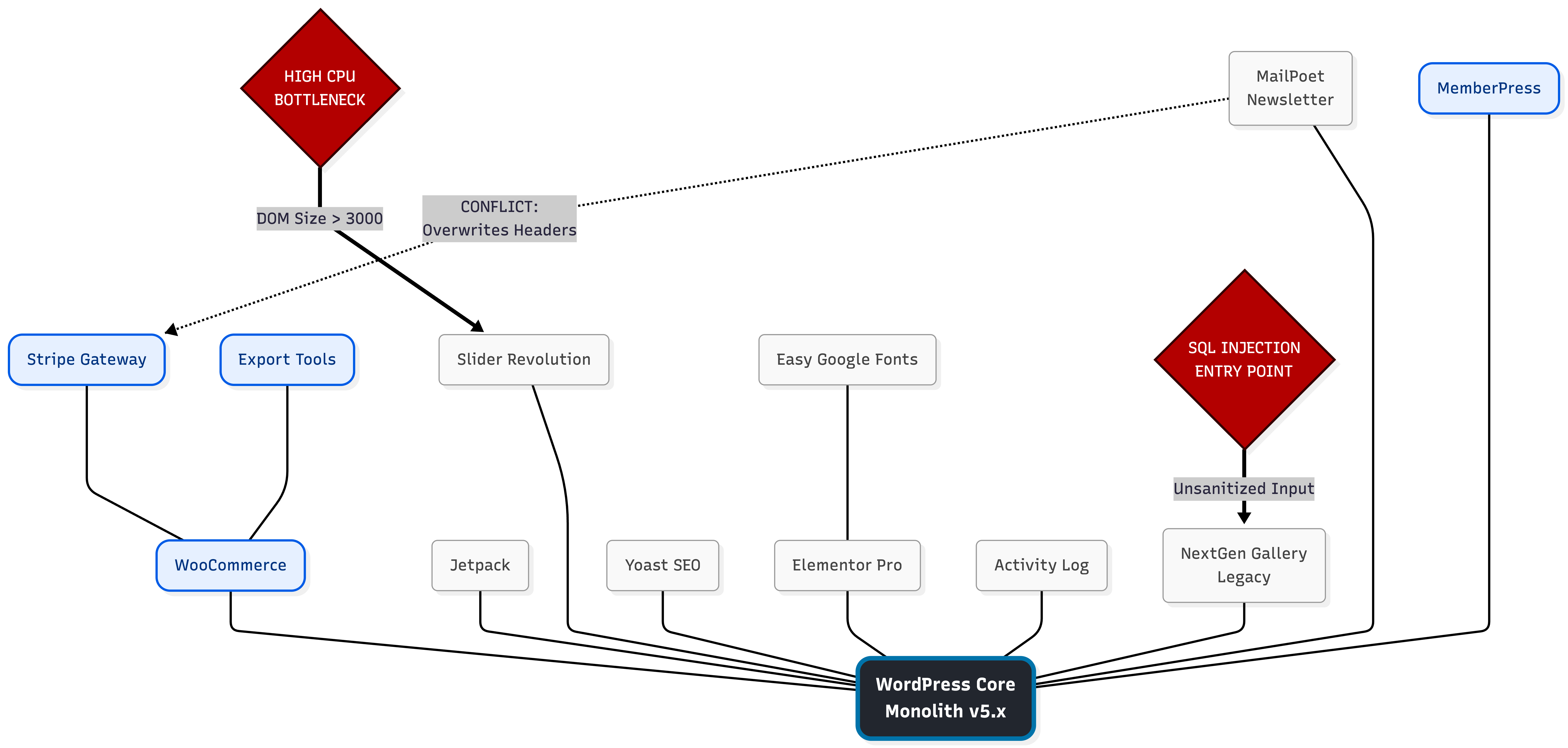
3. The Solution
To address the systemic instability, the platform was migrated entirely from the PHP/WordPress monolith to a RemixJS (React Router v7) environment. We replaced the generic, cluttered backend with a bespoke dashboard engineered specifically for the stakeholders' workflow. This interface exposed only the necessary controls for design and marketing management, reducing cognitive load and eliminating the risk of accidental breakage common in the previous system.
The architecture was redesigned around a "static-first" content delivery model. The admin dashboard was decoupled from the frontend but remained tightly integrated via a build pipeline; every content update triggers a regeneration of static files. This approach ensures that user requests are served instantly without taxing the database. By removing the reliance on third-party plugins and moving security logic to the server level, we eliminated the attack surface for SQL injection and plugin-based exploits, fundamentally securing the application.
4. Engineering Deep Dives
A. Smart Asset Compression In an e-commerce model based on digital design, balancing storage costs with file quality is critical. We developed a custom compression pipeline that reduces file size without perceptible quality loss. Unlike standard libraries which default to 72 DPI, this system was engineered to strictly maintain 300 DPI specifications, ensuring the downloaded assets met the rigorous print standards expected by the end customer.
B. The "Passwordless" Pivot To resolve the friction associated with the legacy authentication system, we implemented a passwordless flow utilizing Magic Email links and Google OAuth. This removed the security risks associated with stored passwords and eliminated the user support overhead regarding login issues. The system was architected to be provider-agnostic, allowing for the integration of additional authentication methods in the future without refactoring the core logic.
C. Modular Feature Expansion Post-migration, the system was structured to support rapid, isolated feature development. We introduced modules for A/B testing, banner customisation, and granular performance tracking that outperformed generic analytics tools. Additionally, custom security modules, such as IP blocking, were developed to run in isolation, ensuring that new defensive measures could be deployed immediately without destabilising the core platform.
5. The Migration Strategy
Migrating from WordPress is complex due to its reliance on a meta-table structure for data serialization. We conducted a deep analysis of the existing database schema to map the relationships between posts, user metadata, and transaction history. Based on this mapping, we wrote extraction scripts to populate the new PostgreSQL database. This process ensured a lossless transition, preserving years of historical data and protecting the stakeholders' intellectual property during the switch.
6. Outcomes
Since the deployment four years ago, the platform has maintained 99.98% uptime with no performance degradation, even during peak holiday traffic. The infrastructure now operates efficiently on budget-tier hardware, significantly lowering monthly overheads. Most notably, the transition ended the cycle of security breaches; there have been zero reported incidents in four years. The stakeholders now view the platform as a stable asset rather than a liability, allowing them to focus entirely on business operations.
7. Scalability Roadmap
The project has transitioned into a long-term maintenance phase. With the core architecture stabilised, development is now focused on value-added features, such as advanced email marketing automation and file format conversion tools. The stability of the current system allows for these enhancements to be researched and integrated incrementally, ensuring the software evolves alongside the business without the risk of regression.
The Impact
We re-architected the platform into a bespoke RemixJS environment with a static-first dashboard. This transition eliminated third-party dependencies and attack vectors, reducing infrastructure costs while ensuring zero security incidents over a four-year operational period.
Run this measurement against your own system.
Retrieval Integrity Diagnostic: £500, fixed scope. Credited in full against the next stage.
What this costs